
Keyword: Hizmet (Gulen) movement


Test of Turkish society
Over the past 11 years, Turkey has been undergoing an important transformation. While it seems to defend secular and modern-looking Western lifestyles, it is trying to come out of the tangle of Kemalism, which is a regime disregarding democratic values of the West. Even if Kemalism had at first dreamed of establishing a real Western democracy, it was later defiled and turned into a hegemony of the elite.

PM threatens business, media and civic groups amid corruption woes
In several veiled references to the Hizmet movement, inspired by Turkish Islamic scholar Fethullah Gülen who has been critical of the government for trying to derail the corruption investigation, the prime minister claimed that the operation was orchestrated by “gangs” and a “parallel state.”

Three ministers resign as one urges PM to step down amid corruption probe
Environment and Urban Planning Minister Erdoğan Bayraktar, in a harsh statement, claimed that he had been pressured to submit his own resignation to save the prestige of the government, adding that the prime minister should also quit as most of the amendments on construction plans mentioned in the corruption investigation were made on Erdoğan’s orders.

Gray domination’ and Turkey’s civil rights challenge
The Hizmet movement, the largest civil society group in Turkey, inspired by Fethullah Gülen, is active in around 150 countries. Hizmet is marked by outstanding schools, dialogue initiatives and relief organizations. Its greatest achievement, however, is the ability to remain independent at all times

Who is the winner?
The Gülen community is a movement of volunteers. The real reason for the row is not the community’s attempt to meddle in politics. It is due to its sheer size and public image. As he did with other groups or communities, Erdoğan sought to take full control of the Hizmet movement in an effort to consolidate his power. Following the defeat of the military tutelage, the government saw a convergence of power. However, the Hizmet movement was not a piece of cake which it could swallow easily. The government had previously purged itself of many bureaucrats who are close to the community.

Ayan: Halkbank operated like Iran’s Central Bank
“The extent of this operation is far beyond the reach of the cemaat [the Hizmet movement],” [“The extent of this operation is far beyond the reach of the cemaat [the Hizmet movement],” Famous Turkish investor Nasrullah Ayan said. He thinks, rather, that powerful international groups could have pulled the trigger or provided technical support to the probe. He pointed to the fact that the operation was launched after the agreement between Iran and the P5+1 nations in Geneva — which gave Iran partial relief from a harsh regime of


Gülen’s curse was misquoted, misinterpreted, GYV chief says
Mustafa Yeşil, chairman of the Journalists and Writers Foundation’s (GYV) executive board, in response to criticisms targeting prominent Turkish Islamic scholar Fethullah Gülen, said the curse uttered by Gülen did not have a direct reference and was poorly comprehended and highly manipulated by some who repeated it.

Thousands in anti-corruption protests; Erdoğan defiant
Thousands took to the streets of İstanbul on Sunday to protest against the government over a corruption scandal that has led to multiple arrests, including sons of two ministers and general manager of the state-run Halkbank.
Twenty-four people, including the sons of two ministers and the head of state-owned Halkbank, have been formally charged in connection with the corruption inquiry that Erdoğan has called a “dirty operation” to undermine his rule.

PM made the wrong choice
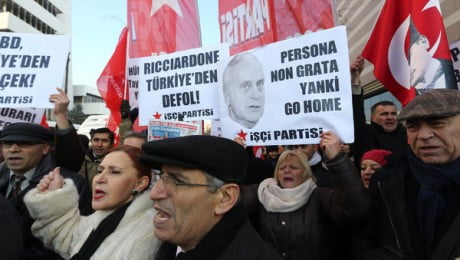
Erdoğan put under the spotlight US Ambassador to Turkey Francis Ricciardone by stating: “Recently, very strangely, ambassadors have gotten involved in some provocative acts. I am calling on them from here to do your job. If you leave your area of duty, this could extend into our government’s area of jurisdiction. We do not have to keep you in our country.” These caustic sentences prove that the AK Party has decided to declare a war not only against the Hizmet movement but also to provoke tensions with the US. Since they have opted for a defensive attack strategy, this reaction does not surprise anyone.

Gov’t lifts confidentiality of MGK docs for publishing in partisan press
Prime Minister Recep Tayyip Erdoğan’s government, which accused the Taraf daily of being a “traitor” for publishing secret state documents last month that include a covert plot against Turkish Islamic scholar Fethullah Gülen and the profiling of citizens, has lifted the confidentiality of some National Security Council (MGK) documents to be released by its partisan media outlets.


