İstanbul hosts dialogue leaders to discuss tolerance in education
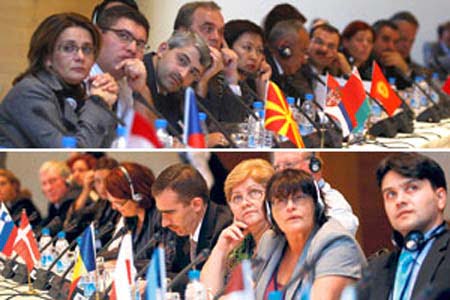
Represantatives from around 30 countries are in İstanbul for a conference titled
Represantatives from around 30 countries are in İstanbul for a conference titled "Tolerance and Dialogue in Education," held to bring European and Asian experts together for discussions on education


Date posted: September 30, 2009

MAHIR ZEYNALOV

“What we are doing here is for the better future of our people, to tackle global threats and institute global peace,” said Rostislav Rybakov, head of the Institute of Oriental Studies, during a conference held in İstanbul on Monday to discuss tolerance and dialogue in education.

The Dialogue Eurasia Platform (DEP) together with the İstanbul Municipal Education Administration and the İstanbul 2010 European Capital of Culture Agency opened a four-day conference in İstanbul on Monday under the title of “Tolerance and Dialogue in Education.”

The primary purpose of the meeting is to bring Europeans and Asians together and propose grounds for discussion. Its organizers also aimed to launch the unofficial opening of the İstanbul 2010 European Capital of Culture celebrations in terms of education. Invitations sent to 42 countries and representatives from 25 countries joined the conference, which plans to bring related educational and dialogue organizations together to deal with tolerance and dialogue in education.

The opening ceremony of the conference started with a presentation on the importance of intercultural and interfaith dialogue and Dialogue Eurasia Platform’s contribution to this.

The presentation stressed the importance of dialogue and tolerance, and people were called on to respect diversity and differences while stressing the significant role of peace and love. “The Dialogue Eurasia Platform is blind to differences, race and diversity and does not recognize any conflicts,” it said.

Head of the İstanbul Education Department Muammer Yıldız, head of Pedagogical Club of European Capitals Boris Jebrovski, co-chair of the Dialogue Eurasia Platform and honorary chair of Russian Academy of Sciences, Institute of Oriental Studies, Rostislav Rybakov, prominent scholar and dialogue activist Nevzat Yalçıntaş, head of the Journalists’ and Writers’ Union Mustafa Yeşil, Deputy Governor for Educational Affairs Harun Kaya and head of the Turkish Parliament Education Commission Mehmet Sağlam were among the participants of the conference.

At the end of the first day, it was announced that the applicable recommendations will be prescribed at the end of the conference. These recommendations will be sent to the participant countries’ education ministries, UNESCO and the UN.

Throughout the conference discourse on peace, love, respect of diversity dominated the speeches by all speakers. The speakers were representing both educational ministries of different countries and educational organizations from various countries. “Our differences are our beauty,” said Yıldız, head of İstanbul Education Department. “We educators are responsible for building an environment of tolerance and dialogue. Our job is to contribute to universal peace.”

The head of the Institute of Oriental Studies, Rybakov, listed seven guiding principles for global peace. “İstanbul is the seventh golden principle. Its mosaic of different cultures and religions is a wonderful sign of coexistence and respect for diversity,” he said. Drawing similar lines between Indian peace activist Mahatma Gandhi and Turkish scholar Fethullah Gülen, Rybakov said Mahatma Gandhi had certain political motives yet Gülen is a “gardener.” “Fethullah Gülen is an initiator of a new culture, a new man who is ready to love,” Rybakov concluded.

The conference is expected to finish on Sept. 30 with policy recommendations for different organizations and ministries of education with respect to dialogue and tolerance in education.

Source: Today’s Zaman, 29 September, 2009


Related News

What can Christians learn from a global Islamic movement?

Clearly, the Gülen movement is reeling from the campaign against it in Turkey. However, it has been a genuinely international movement for many years. As it struggles in Turkey, it may well flourish elsewhere among those who react against Erdoğan’s vitriolic campaign against Gülen.

Social, legal sanctions needed in fight against domestic violence

İPEK ÜZÜM, İSTANBUL Social sanctions will be necessary alongside legal measures if domestic violence is to be curbed in Turkey, according to experts from a number of fields who gathered at a conference of the Journalists and Writers Foundation (GYV) in İstanbul on Sunday, marking the International Day for the Elimination of Violence against Women. […]

Prime Ministry asks president to purge ‘parallel state’ in his office

The Office of the Prime Minister has submitted a list of people who are allegedly members of the Hizmet movement to President Abdullah Gül, the Taraf daily claimed on Thursday, as part of widespread government attacks on the movement.

Peace and prosperity for Turkey lies in philosophy of Nursi says Altan Tan

On one hand he is a devout Muslim, and former member of the conservative Welfare Party (Refah Partisi), which was thrown out of the government in 1997 after a military memorandum, commonly known as the February 28 post-modern coup. Equally important for Tan is his identity as a Kurdish political figure, seeking political rights for his people and an end to conflict between armed rebels and the state.

Lawyer Karahan: Hate crimes against Hizmet can be prosecuted at ECtHR, ICC

The Savings Deposit Insurance Fund (TMSF) has taken over management control of some of the privileged shares of Bank Asya as part of a government-operated crackdown on institutions affiliated with the Gülen movement, also known as Hizmet, and shareholders will be filing a lawsuit against the action, but this week’s guest for Monday Talk has said it is likely that the case will end up at the European Court of Human Rights and even at the International Criminal Court.

I object to AK Party’s ‘New Turkey’

At this point, we need to state that the third term in office which the prime minister Erdogan refers to as the period of mastery appears to be a goal of converting society through a single cultural identity rather than a period of restoration that will strengthen social peace.

Latest News

Turkish inmate jailed over alleged Gülen links dies of heart attack in prison

Message of Condemnation and Condolences for Mass Shooting at Bondi Beach, Sydney

Media executive Hidayet Karaca marks 11th year in prison over alleged links to Gülen movement

ECtHR faults Turkey for convictions of 2,420 applicants over Gülen links in follow-up to 2023 judgment

New Book Exposes Erdoğan’s “Civil Death Project” Targeting the Hizmet Movement

European Human Rights Treaty Faces Legal And Political Tests

ECtHR rejects Turkey’s appeal, clearing path for retrials in Gülen-linked cases

Erdoğan’s Civil Death Project’ : The ‘politicide’ spanning more than a decade

Fethullah Gülen’s Vision and the Purpose of Hizmet

In Case You Missed It

Cold Turkey: Erdogan’s withdrawal from democracy

Karzai honored Turkish schools in his country

Report exposes death from torture of Turkish teacher in police custody

Fethullah Gulen responds to videocassette allegations

Lawyer of arrested officers detained for Gülen movement propaganda

Will the Gulen Movmement found a political party?

Establishing a Culture of Coexistence and Mutual Understanding Conference convenes in Nigeria

Copyright 2026 Hizmet News