Concluding statement of the International panel on Mary announced

Date posted: December 8, 2013

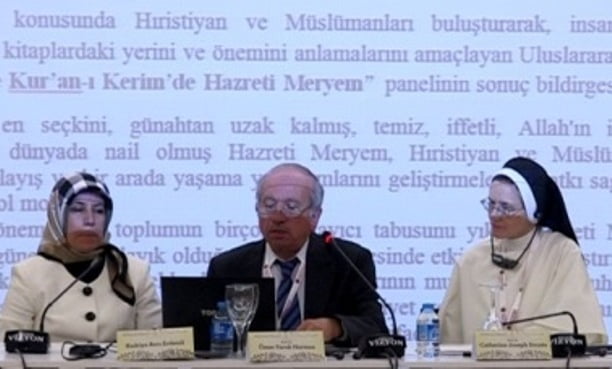
The international panel, titled “Mary in the Holy Scripture and Qur’an,” which was jointly held by the Journalists and Writers Foundation’s (GYV) Intercultural Dialogue Platform (KADİP), the Tevere Institute and İzmir Intercultural Dialogue Center (İZDİM), was concluded with a statement.

Chaired by Professor Ömer Faruk Harman, the Concluding Statement Committee consisted of Professor Catherine Joseph Droste, Associate Professor Mustafa Alıcı, Associate Professor İsmail Taşpınar and Kadriye Erdemli.

The concluding statement of International Panel on Mary in the Holy Scripture and Qur’an

The concluding statement of the International Panel on Mary in the Holy Scripture and Qur’an, which sought to bring Christians and Muslims together to discuss Mary and help people understand the place and significance of Mary in holy books, is as follows:

1- Mary was the most distinguished, innocent, pristine, and chaste of all women and she attained God’s favor and benevolence before she died. As such, he represents a significant role model for Christians and Muslims to develop a mutual understanding and foster coexistence.

2- Having destroyed many exclusionary taboos of her time, Mary played an effective role in the empowerment of women.

3- We have much to inspire from Mary as an epitome of patience, humility, submission, devotion and belief for treating spiritual crises and diseases that haunt humanity in general and women in particular.

4- It is quite natural that both Christian and Islamic sources have a good level convergence as well as divergence about Mary. However, it is clear that it would be more advisable to focus on common grounds rather than differences and accept everyone as they are.

5- Given the fact that it is a must to have a thorough understanding of Mary, an epoch-making woman, both from a socio-cultural and theological perspective, it is recommended that the panel on “Mary in the Holy Scripture and Qur’an” should be regularly held with differing themes every year.

Source: Intercultural Dialogue Platform , December 8, 2013


Related News

Erdogan’s Journey – Conservatism and Authoritarianism in Turkey

What happened to Recep Tayyip Erdogan? The Turkish president came to power in 2003 promising economic and political liberalization. But under his rule, Turkey has instead moved in a profoundly illiberal, authoritarian direction, which some feared was Erdogan’s true agenda, given his background in Islamist politics. Rather, Erdogan has become something more akin to a traditional Middle Eastern strongman: consolidating personal power, purging rivals, and suppressing dissent.

Erdoğan and Gülen: The Marriage of Convenience

Religiously, the Gülen Movement both reflects the long tradition of Turkish Sufi brotherhoods, and Gülen’s own emphasis on societal change through education, humanitarian activism, and interfaith dialogue. Gülen never sympathized with, or adopted, the AKP’s more conservative form of political Islam.

Rumi Forum bestows Peace and Dialogue Awards

ALİ H. ASLAN The Rumi Forum, a think tank established by Turks living in Washington, D.C., to foster intercultural dialogue, has presented its traditional Peace and Dialogue Awards. The 2010 Rumi Peace and Dialogue Awards ceremony was held on Tuesday at the National Press Club’s Ballroom in Washington, D.C. The think thank gave awards to […]

No evidence Gulen movement is guilty of subversive activities

The suggestion that Mr Gulen intends to create a new religious political order in Turkey is untrue. He has spoken against political Islam and has always supported a democratic system. In one of his speeches, he explained: “Islam does not propose a certain unchangeable form of government or attempt to shape it.

3,623 Aggravated Life Sentences Sought In Turkey For Scholar Fethullah Gülen

Turkish prosecutors, part of a judiciary strongly under the influence of Turkey’s autocratic President Recep Tayyip Erdoğan, have demanded 3,623 aggravated life sentences for Turkish-Islamic scholar Fethullah Gülen, who lives in self-imposed exile in the US.

Bank Asya shares skyrocket after trading resumes

The Islamic bank has been in the spotlight since Turkish media reported that state-owned companies and institutional depositors loyal to Prime Minister Recep Tayyip Erdoğan had withdrawn TL 4 billion ($1.8 billion), or some 20 percent of the bank’s total deposits, because the bank’s founders include sympathizers of cleric Fethullah Gülen, a former-ally-turned-critic of Erdoğan.

Latest News

Turkish inmate jailed over alleged Gülen links dies of heart attack in prison

Message of Condemnation and Condolences for Mass Shooting at Bondi Beach, Sydney

Media executive Hidayet Karaca marks 11th year in prison over alleged links to Gülen movement

ECtHR faults Turkey for convictions of 2,420 applicants over Gülen links in follow-up to 2023 judgment

New Book Exposes Erdoğan’s “Civil Death Project” Targeting the Hizmet Movement

European Human Rights Treaty Faces Legal And Political Tests

ECtHR rejects Turkey’s appeal, clearing path for retrials in Gülen-linked cases

Erdoğan’s Civil Death Project’ : The ‘politicide’ spanning more than a decade

Fethullah Gülen’s Vision and the Purpose of Hizmet

In Case You Missed It

Pro-Erdogan journalist says killing Gülen followers, even their babies, a religious obligation

Bridge-building in ‘enemy country’ – Story of a Turkish asylum seeker in Greece

Erdoğan admits calling Habertürk executive to change reporting during Gezi protests

Pacifica Institute San Diego holds its Dialogue and Friendship Dinner

Local Look – The Turkish Cultural Center of New Hampshire

Peace Curriculum Includes Fethullah Gulen

Islamic scholar Gülen says Turkey’s graft scandal can’t be covered up

Copyright 2026 Hizmet News