
Fethullah Gulen Suggests Nonviolent Options to Young Activists
Date posted: December 14, 2012
Fethullan Gulen suggests some ways to the young activist group that are not based on violence and that are for peace. I think it’s necessary to understand the significance of education and school projects in particular. I try to express this in my articles.
Akman: Why are you more interested in sociology of religion?
Ozdalga*: During the first half of the 1970s, there were important developments for the left in Turkey, and people had hopes for that movement; however, things did not go well through the end of the ’70s. The CHP lost a considerable number of votes in the 1979 Senate elections. The party’s administrative staff could not channel the power it received from the people into the expected changes and reforms that were necessary for social peace at the time. Since all of the parties had been closed down after the Sept. 12 coup, disorder emerged in politics, and some movements started in the Islamic area. So I began to be interested in religious sociology in order to better understand Gulen movement.
Akman: If you had stayed in Sweden, you wouldn’t have chosen that subject, would you?
Ozdalga: That’s not for certain. I would have chosen it, anyway, but I would have studied it as an outsider. Living in Turkey was an important advantage. These developments were taking place in front of my eyes. I was able to follow developments in the media every day, and it was also part of my professional life at the university. Turkey is, in fact, a terrific laboratory.
Akman: The subjects you studied are kind of ‘objectionable’ topics in Turkey. We can see that Turkish sociologists are not very willing to study these topics. You are not afraid of being stigmatized and do not mince your words. You were able to study these issues very easily. Is this because you have the self-confidence of a Westerner?
Ozdalga: The existence of these ‘objectionable’ issues is one of Turkey’s problems. Actually, every society has some issues it avoids, but there are too many in Turkey, and they are unnecessary. This concept is an obstacle for Turkey’s development and improvement. For instance, say you are doing research on a subject — let’s take the turban (headscarf) issue. But if you try to do this by avoiding the prejudices that are particularly dominant in the elite groups, they immediately begin to portray you as if you were a part of the groups that you are studying. And you just turn into a person with a headscarf without even wearing one. Like you said, a case of stigmatization is occurring. And this can be pretty offensive for an academician who is trying to be serious and objective. However, there are now many academicians who study these issues in Turkey.
Akman: But in small numbers. How many sociologists do you know studying the same subjects that you do? More than two?
Ozdalga: Firstly, Binnaz Toprak and Nilufer Gole, who are well known on these issues, come to mind. But let’s not be unfair. There are many colleagues in ODTU sociology circles alone, adults and young people, studying Islamic culture and Islamic movements. They are also at Bilgi, Yildiz, Marmara, Bahcesehir and Konya Selcuk universities. I consider myself neither alone nor a lot braver than the others.
Akman: Why don’t you consider yourself to be like that? You studied the Fethullah Gulen movement, the headscarf issue and Alawiism.
Ozdalga: I did not do original research on Alawiism, but I organized a conference about it about four or five years ago. I was assigned at the time as project director at the Istanbul Swedish Research Institute. Our Alawiism conference was one of a series about Islamic society and culture. Others were about Nakshibendi tarika, Sufism and music, democracy and civil society. I personally researched the headscarf and the Gulen movement. The reason I chose the headscarf issue was the injustice towards students with headscarves that I saw at the university. I thought the prejudice towards those girls the manners and punishment based on those prejudices were very provocative. That’s why I wanted to document this issue by working among students with headscarves. There was a headscarf problem in various countries in Europe as well, and I thought I could present a different dimension to discussions on the problem with the work I would do.
Akman: What aspect of the Gulen movement attracted your attention?
Ozdalga: What attracted me were the young teachers of the movement’s schools and its businessmen. In the early 1990s they opened schools and workplaces under very tough conditions in the Central Asian republics. Such an undertaking required a lot of self-sacrifice. Not only self-sacrifice, of course, it also had something to do with being an adventurer. Young teachers who have gone to distant countries have had incomparable experiences and thus have prepared themselves for life differently. They tried to add new dimensions to their lives and showed that they were open to new experiences by breaking their routine lives, which was kind of extraordinary. This is a visionary tendency, and it necessitated courage as well. Actually, this enthusiasm was what caused me to do research on this movement. I wondered where this power and aspiration came from.
Akman: You had two articles published about the Gulen movement, didn’t you?
Ozdalga: Yes. One is about the earthly asceticism and activism in the Gulen movement, and the other is about laicism and secularization. In general, activism is regarded as something dangerous in Turkey. It is viewed as if activism were equal to militancy and activities based on violence, whereas activism has other dimensions and is important, particularly among young people. When a person is young, he or she does not want to work for himself or herself only. He or she would like to do things not only for the ego but for the good of other people as well. Fethullan Gulen suggests some ways to the young activist group that are not based on violence and that are for peace. I think it’s necessary to understand the significance of education and school projects in particular. I try to express this in my articles.
Akman: Sahin Alpay summarized the main ideas in your last article quite nicely. You claimed that despite the powerful religious appeal of the Gulen movement, it [the religious appeal] led the movement towards secularization. You found some similarities between their activities and 19th century Christian missionaries’ activities in terms of an education mission. You said, ‘The guiding power is religion, but spreading religion is not their intention.’ You stated that their common features are ‘to lead a religious and self-sacrificing life, a deep interest in gaining knowledge, the desire to spread knowledge and an initiative spirit in business.’
Ozdalga: The religious dimension is important for that movement. This piety is not introverted, but rather is extroverted. The concept of service is very important. They would like to make significant contributions to people in the world. One of the ways to do good for people is to give them a good education. As far as I am concerned, the number-one goal here is not to spread religion to high school students; however, students who are close to Fethullah Gulen’s opinions are assigned to various places within the movement after graduating from high school, and thus the movement gains new members. But the religious influence on the students should not be exaggerated. There can be encouragement, but students are not forced, at least not widely. The education in the courses is secular; I have no doubt of that. The Education Ministry’s curriculum is followed.
Akman: There is another conclusion that is more interesting. You say, ‘Since they express their mission as a humanist project, it weakens the religious principles of the project.’
Ozdalga: Yes. According to the general opinion of official circles, the Gulen movement represents religious reaction. I say no, this community has accepted laicism in principle; they even contribute to secularization by expanding school activities. Since they are not imam-hatip (religious high school) schools, it is a normal secular education. Paradoxically, it is a movement embracing religious values in the practice of worldly aspects.
Akman: So does a religious community have a side that destroys itself?
Ozdalga: Not destroys, but weakens. I sensed something in the research I did: In order to get along with the present system, while religious values are being kept in the background, humanistic values are emphasized. For instance, bringing students up as good human beings is more important in the schools than bringing them up as good Muslims. Isn’t the Islamic base weakened in this sense? Don’t the people in this movement have such a concern? Is a conflict being experienced over this issue? There has been a drawing closer to Mevlana in the Gulen movement based on these humanistic tendencies; however, while the secularists should be happy about such tendencies, they ignore them and still talk about religious reaction.
Akman: Why don’t state officials evaluate the ‘event’ as you do?
Ozdalga: They don’t because they have a totally different agenda. They evaluate these movements first of all as security problems. I and researchers like me try to understand a religious movement with its sociological, cultural, historical and complicated aspects. While doing this, we try to stay as far away as possible from the ideological agenda. But although there are deep differences concerning the goal issue, we would prefer that the information we obtain be taken more seriously. I think this information better and more profoundly reflects reality.
Akman: In the social sciences, 2 times 2 is not always equal to 4, as it is in science. How do you work?
Ozdalga: You are very right. The social sciences are different from the natural sciences. Science cannot conduct an ultimate arbitration here. It’s not possible to separate an analysis in the social sciences from the researcher’s values. That’s why, both personally and sociologically; one needs to stay away from their values as much as possible. We try to discipline ourselves in that way. We constantly need to struggle against value judgments. Since we are more conscious about perspective and values, we, as social scientists, can do more credible research in comparison to other environments.
Akman: Accusations in lawsuits contradicted your thesis. How did you solve this in your head?
Ozdalga: It’s very difficult to have an opinion about this issue because the accusations are probably based on the state’s special intelligence sources. I do not want to talk about the cases that are now in progress. We as social scientists work totally with open sources. We know, more or less, the ideas sustaining the movement. These are not ideas that threaten the present system. I learned from the interviews I had with teachers in Gulen’s schools, both in Turkey and in Central Asia, that they are not different from other teachers in terms of professional goals and targets. Of course, the people of the Gulen movement are religious. I mean they take religion more seriously in comparison to people in other environments. But this passion does not push them to betray the state! Their faith is something more concerned with private life. Schools and classes are not used for religious propaganda.
Akman: So are you saying ‘This movement does not have a political ambition’?
Ozdalga: Yes, I think so. It does not want to be an opposition movement. Even the Gulen movement sometimes tries too hard to get along with the system.
Akman: What do you say about the system viewing them as a problem despite this fact?
Ozdalga: Most official circles are prejudiced against this movement, whereas the Gulen movement is very careful not to have conflicts with the authorities. I sometimes think they should raise their voices and speak more clearly. That’s why the accusations against the movement seem wrong to me.
Akman: How would you define yourself from the aspect of religion?
Ozdalga: I was born a Lutheran, that is, a Protestant, like most Swedes. When I was young, religious education in Sweden was a lot more serious both in schools and in the official church environment in comparison to today’s situation. I come from a generation that was raised reading the Bible and the Torah and learning hymns. I have a weakness for mystical feelings, but I am not a person who practices religion.
Akman: What do you think about the CHP’s attitude of being the pursuer of the state’s official perception of laicism?
Ozdalga: I think it would be better if they were more liberal about these issues. When the word ‘religion’ is mentioned, the first thing that still comes to mind in the CHP is doubt and control. But there is a conflict within the party about these matters. They would like to be close to the public. For instance, they call on women with headscarves to vote for them in the elections, yet they continue to act as if they were chief inspector of the state when it comes to matters like dress and religion.
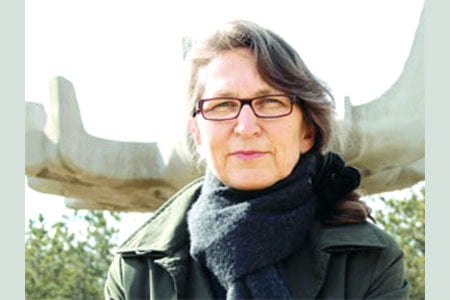
This is an interview by Nuriye Akman with sociologist Elisabeth Ozdalga about Fethullah Gulen and religion/secularism issues in Turkey. Akman interviewed Ozdalga in June 2003.
Source: Zaman June 8, 2003. Orijinal interview is in Turkish. English translation is retrieved from fgulen.com.
* Elisabeth Ozdalga is a Swede who has been living in Turkey for the past 30 years. Her husband, Haluk Ozdalga, is a member of the Republican People’s Party (CHP) administrative staff. Mrs. Ozdalga received a scholarship from the Education Ministry when she came to Turkey in the early 1970s.
She studied at Middle East Technical University (ODTU) as a special student and attended in particular the lectures of Mubeccel Kiray. She was awarded a Ph.D. from Goteberg University after completing a doctoral thesis about the CHP. Attracted by new formations in the CHP, she thought that if she studied the sociological and historical aspects of the organization, she would at the same time be able to learn about Turkey as a society. She has recently been studying the religious sociology. Mrs. Ozdalga jointed ODTU as an academician in 1982; however, she never lost touch with Sweden. She is still a Swedish citizen and has two children who are studying abroad. I believe that as a sociologist Mrs. Ozdalga’s assessments as well as the questions she asks will attract the interest they deserve.
Tags: Fethullah Gulen | Interviews on Fethullah Gulen | Turkey |


