
News
UN representative found evidence of torture in Turkish prisons
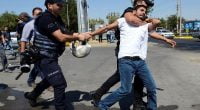
The majority of the abuse occurred during the times of arrest and interrogation, his report noted, adding that most of those who have been subjected to torture have not filed complaints “for fear of retaliation against them and their families and because of their distrust in the independence of the prosecution and the judiciary.

Turkey’s Economy Suffering Enormous Post-Coup Purges
Since the attempted military coup on July 15, the government, empowered by a state of emergency, has fired or suspended about 125,000 people, of whom nearly 40,000 have been arrested, and tens of thousands of others taken into custody. As a result, roughly 800,000 people have been completely cut off from any economic safety net.


Turkey torture claims in wake of failed coup
Kamil continues. “‘If you don’t speak, we’ll bring your wife here and rape her in front of your eyes’, they said. Then they took me to a dark room and tried to forcefully insert a baton into my anus. When they couldn’t do it, they left. Maybe I will forget the other torture – but for the sexual part, it is carved into the dirtiest corner of my heart.”

Post-coup purge will affect Turkey’s education sector for decades
With more than 120,000 public workers suspended and nearly 40,000 people in prison, the aftermath of Turkey’s failed July 15 coup is being felt across every part of society, including its highest-ranked schools. The day after the coup attempt, 1,577 deans — working at nearly every university in the country — were forced to resign. An estimated 200,000 students were left in limbo after the closure of 15 universities and 1,043 private schools.

Pak-Turk schools won’t close, says Education Minister
“The government will neither close down Pak-Turk schools in the country nor will it hand them over to anyone,” announced the Minister of State for Federal Education and Professional Training Baligh Ur Rehman. According to the minister, Pak-Turk schools are registered with the relevant Pakistani authorities and therefore, they will continue to operate in the country.

Nigeria: Hizmet Movement not terrorists
The Concerned African Youth against Tyranny (CAYAT) has denied report that the Fethullah Gulen Movement and Hizmet Movement are terrorist groups. National Coordinator of the organisation, Mr. Musa Shaba said yesterday in Abuja that contrary to claims by the Turkish government the movement has become the face of Turkey in Nigeria and Africa.

Farewell of Pak-Turk Teachers: Symbolic Burial of a Heart
All the parents were depressed and disappointed at the forced exit of Turkish staff. They looked sad with tearful eyes bade farewell to the Turkish staff. Mr. Osman Arslanhan along with the other Turkish staff made a symbolic burial of a heart which was full of hearty wishes of the Turkish staff and drawings made by the Turkish children. The heart was buried with tears in the eyes by all the Turkish staff.

Emotional farewell for Turkish teachers
The students, who have been groomed and educated by the Turkish teachers at the PakTurk schools, seem down in the dumps since word about their mentors’ departure got round. The teachers are scheduled to leave Pakistan in the coming week following the government’s deadline.

Our three-month ordeal in Turkey’s maximum prison -Nigerian students detained over coup saga
Notwithstanding such aims and the benefits to Turkish citizens and others around the globe who enjoy scholarship and the benefits of quality education, all such pro-Gülen educational organisations, including the ones established in Nigeria have been branded as enemies by the Turkish government. “I have never heard that the Turkish schools in Nigeria have done anything illegally since the time they began operation in Nigeria; I attended one of such excellent schools so, I see no reason why the school should be closed,” Mohamed said.

Does Pakistani law allow you to deport Turkish teachers, Nawaz Sharif?
The recent controversy that has emerged regarding the PakTurk school system is troubling to say the least. PakTurk schools started popping up all over Pakistan during last decade. Turkey has always carried a strong brand value in Pakistan and it is therefore not surprising that the school system ostensibly embodying the best of Pakistan and Turkey was an instantaneous hit with parents.

Turkey’s post-coup brain drain
Bekir Cinar was working as an assistant professor at the political sciences department of Suleyman Sah University when it fell victim to the crackdown. He says that many academics with different views were working at the university. Cinar is currently continuing his scientific work at a British university. He considers this a major loss for Turkey, not least because it takes 20 to 30 years to become an academic.


