Abant Platform to discuss framework of new constitution

Date posted: March 6, 2012

5 March 2012 / TODAY’S ZAMAN, İSTANBUL

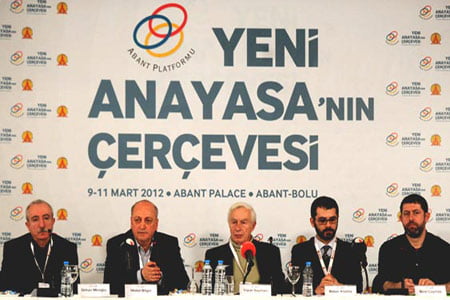
The prestigious Abant Platform, which has tackled pressing issues facing Turkey since its establishment in 1998, will aim in its next meeting to contribute to the shaping of Turkey’s new constitution.

The 26th Abant meeting, which will be held from March 9 to 11 in Turkey’s northwestern province of Bolu, will bring together a wide spectrum of intellectuals, lawyers, political leaders and journalists to discuss the problematic areas of, and propose solutions to, the constitutional drafting process. Parliament Speaker Cemil Çiçek will be among those attending the meeting.

Participants will examine the constitutional process through the following subjects — citizenship and identity, mother tongue education, local governments in the balance of a unitary state and autonomy, freedom of religion, religious education and the position of the president in the constitution.

Former head of the Supreme Court of Appeals Sami Selçuk, Turkish-Armenian biweekly Agos Editor Rober Koptaş and academics from various universities and journalists from Turkey’s many dailies will lead the discussions.

As with every Abant meeting, the platform will release a summary declaration arising from the discussions’ conclusions.

The Abant Platform is an independent think tank that takes its name from Lake Abant in the province of Bolu, the location of its first meeting. It is one of the most well-known programs of the Journalists and Writers Foundation (GYV).

The GYV was founded in 1994. Its mission and work were inspired by the GYV’s honorary president, Islamic scholar Fethullah Gülen.

Source: Today’s Zaman http://www.todayszaman.com/news-273342-abant-platform-to-discuss-framework-of-new-constitution.html


Related News

Gov’t cancels Kimse Yok Mu’s previously obtained permissions

Following an abrupt Cabinet decision to remove the status of public interest of Kimse Yok Mu, the largest volunteer and global aid organization based in Turkey, the government has also cancelled the charity’s previously obtained permissions to collect donation until the end of this year.

Turbulent times [in Turkey due to corruption probe]

The arrest of several people close to the government, including three ministers’ sons, accused of taking significant bribes, has shaken the ruling Justice and Development Party (AKP) government to the core and plunged Turkey into political uncertainty. Whether it is the case or not — the Gülen movement denies it — the timing of the arrests has created the widespread perception that the investigation is linked to the growing tension between the AKP and the Gülen movement, also known as Hizmet.

The Guardian view on Turkey’s repression: stop this stalemate

Turkey’s western allies are alarmed, but against a complex geopolitical backdrop, they have chosen discretion rather than valour. After the EU parliament last week voted to freeze EU accession talks with Turkey, Mr Erdoğan lashed out by threatening to open the country’s borders to migrants heading to Europe. This is tantamount to blackmail.

Islam is compatible with Democracy, despite Turkey’s recent example

Despite the outward appearance of Islamic observance, Erdogan regime represents a complete betrayal of core Islamic values. These core values are not about a style of dressing or the use of religious slogans. They include respect for the rule of law and the independence of the judiciary, accountability for the rulers and the preservation of inalienable rights and freedoms of every citizen.

Plot against Gülen movement put into action based on lies, false confessions

An alleged secret plot against members of the faith-based Gülen movement — inspired by Turkish Islamic scholar Fethullah Gülen, which became public last year, is being put into action step by step based on questionable testimonies obtained from secret witnesses, informants and anonymous complainants leading to criminal prosecutions apparently orchestrated by political authorities.

Why Mr. Gülen was targeted

The main difference between Islamic scholar Fethullah Gülen and the politician who became Prime Minister Recep Tayyip Erdoğan is that the former is vehemently opposed to the use and abuse of Islam as a political ideology and party philosophy while the latter sees the religion as an instrument to channel votes and to consolidate his ranks among supporters.

Latest News

Turkish inmate jailed over alleged Gülen links dies of heart attack in prison

Message of Condemnation and Condolences for Mass Shooting at Bondi Beach, Sydney

Media executive Hidayet Karaca marks 11th year in prison over alleged links to Gülen movement

ECtHR faults Turkey for convictions of 2,420 applicants over Gülen links in follow-up to 2023 judgment

New Book Exposes Erdoğan’s “Civil Death Project” Targeting the Hizmet Movement

European Human Rights Treaty Faces Legal And Political Tests

ECtHR rejects Turkey’s appeal, clearing path for retrials in Gülen-linked cases

Erdoğan’s Civil Death Project’ : The ‘politicide’ spanning more than a decade

Fethullah Gülen’s Vision and the Purpose of Hizmet

In Case You Missed It

Turkish, Russian businessmen convene at forum

Fethullah Gülen on Acts of Terrorism – in light of Paris and Beirut

Erdogan critic calls jailing of his mother and brother ‘perverse’ and ‘politically motivated’

Rebecca Harms: Working in Gülen-linked educational institutions not a crime

Turkish NGO Kimse Yok Mu handed over 296 houses for flood affectees

Plot against Gülen movement in tatters as suspects confess to false testimony

Turkish charity Kimse Yok Mu represents Turkey at UN summit

Copyright 2026 Hizmet News