
Experiences with Hizmet and the Followers of Fethullah Gülen
Date posted: July 21, 2012
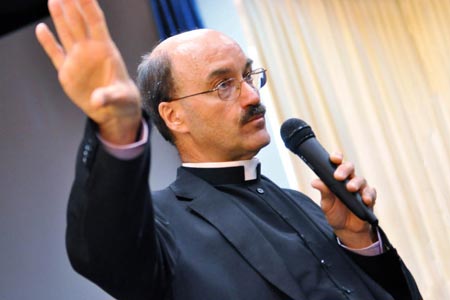
Fr. Leo D. Lefebure* 03 July 2012, Tuesday
The members of Hizmet have been unfailingly gracious and cordial, respectful of Christianity and mindful of the many values shared by Muslims and Christians. Their concern to build constructive relationships and to collaborate in building interreligious understanding is inspiring.
Since the 1990s, I have been involved in a variety of dialogues with Muslims in the United States and around the world. When I moved to Georgetown University in the summer of 2005, I became acquainted with the members of the Rumi Forum in Washington, DC, which is affiliated with the international Islamic movement known as Hizmet, a Turkish word that means “Service.” Since the movement is inspired by the example and writings of Turkish Muslim leader Fethullah Gülen, outside observers often refer to this as “the Gülen movement.” At the time I moved to Washington, DC, the director of the Rumi Forum was Ali Yurtsever, a dynamic, friendly leader with a seemingly insatiable interest in interreligious dialogue and friendship.
When I arrived in Washington, I found that Georgetown University hosted a Muslim-Christian dialogue in which the majority of the Muslim participants were affiliated with the Rumi Forum. We discussed a variety of topics of spiritual experience and interreligious relations, including the religious poetry of Jalal al-Din Rumi (1207-1273), the policies of the Ottoman Empire regarding Jews and Christians, the theology of Bediuzzaman Said Nursi (ca. 1877-1960), the writings of Gülen, and the biography of Ignatius of Loyola. The conclusion of each dialogue consisted of the enjoyment of delicious Turkish food, courtesy of the Rumi Forum. Eventually, the dialogue expanded to include Jewish participants as well. Among the participants affiliated with the Rumi Forum were Ali Aslan, a journalist who covers Washington, DC, for Zaman Newspaper, and Jena Luedtke, who is the interreligious representative of the Rumi Forum.
After a dialogue one evening, Ali Aslan asked me if I had ever been to Turkey, and I said that I had not. He proceeded to notify Ali Yurtsever that I should be invited to join one of their intercultural tours of Turkey. And so it happened that the following May I found myself in Turkey with Ali Yurtsever, Jena Luedtke, and a very interesting group of participants. One of the greatest contributions of the Rumi Forum is to bring together people with common interests who otherwise would likely not know each other. In our traveling group were a retired U.S. diplomat and his wife with long experience in the Middle East, the former dean of a law school, a Reform rabbi and his wife, the minister of Unity Church in Fairfax, Virginia, and a Franciscan sister who works in Muslim-Christian relations and who had written a short book about the visit of St. Francis of Assisi to Sultan Malik al-Kamil in 1219, during the fifth Crusade. Francis, who saw himself as a man of peace, traveled through the Crusader army and sought an audience with the sultan, who apparently viewed him as similar to the Sufi holy men. Their encounter stands as a hopeful sign of the possibilities for respectful, cordial dialogue even during periods of suspicion and conflict.
On our tour of Turkey, we visited the major sites of Istanbul, including the magnificent edifices of Hagia Sophia, the Blue Mosque and the Suleimanniyya Mosque, as well as the traditional Topkapi Palace of the sultans and the nineteenth-century Dolmabace Palace along the Bosphorus. We took a beautiful evening dinner cruise on the Bosphorus and later visited the headquarters of Zaman Newspaper and the Authors and Writers Forum in Istanbul. In a number of cities we visited schools sponsored by Hizmet. We visited sites of early Christians in Cappadocia, including a monastery carved into the side of a hill and a village carved underground, where Christians could hide from Roman persecutors and escape through underground tunnels. In Ephesus we visited the place that is venerated as the place where Mary the mother of Jesus lived the last years of her life. We witnessed the profound devotion that both Muslims and Christians have to her in praying at this site. Mary is honored in the Qur’an as the virgin mother of the prophet Jesus; she is the only woman named by her own name in the Qur’an, and she is also the only woman to have a sura (chapter) of the Qur’an named after her. Thus she has been held up as a bridge to the future for shaping Muslim-Christian relations.
As we were riding on the bus toward Ephesus, Rabbi Larry Forman came up to me and said, “Leo, there was a creed of Ephesus, wasn’t there?” I answered, “Yes, there was a council that issued a declaration there.” He continued, “I think we should write our own statement from Ephesus, and you are the one to draft it.” As I bounced up and down on the bus, I pulled out a piece of paper and drafted a preliminary statement based upon our experiences in Turkey. We circulated it and invited suggestions to improve it. Later, on our last full day, we had lunch in a gorgeous room along the Bosphorus at the Dolmabace Palace. As we finished eating, the rabbi led the group in discussing what we wanted in the statement. I took notes as one person after another reflected on our experience together. Later I composed another draft, incorporating many additions from our companions. We later circulated this through e-mails and finally delivered it to the Rumi Forum as an expression of our delight with the trip and our sharing of their concerns.
We also visited Fatih University in the western suburbs of Istanbul, an English-language university supported by Hizmet. Six months later, when I returned to Istanbul for a conference on Said Nursi sponsored by the Istanbul Foundation for Science and Culture, the dean of Fatih University invited me to come there and to deliver a lecture on “How Universities Can Contribute to Inter-Civilizational Dialogue.” After offering some general comments, I shared many of our experiences at Georgetown University.
In Washington, DC, the Rumi Forum is active in a wide variety of initiatives. For example, the Forum co-sponsored a conference at the Catholic University of America on Islam in America, at which I delivered a paper on “Muslim-Christian Relations in the United States.” The Rumi Forum hosts an annual interreligious awards banquet. Some of these celebrations have been held in an office building of the U.S. Congress on Capitol Hill, and at the end of one evening, the Rumi Forum presented whirling dervishes from Turkey dancing as an expression of prayerful meditation. Later that week, the dervishes also danced in Hebrew Union Congregation, one of the most prominent synagogues in Washington, DC. My Turkish friends believed that this was the first time in history that dervishes had danced in a synagogue. The Rumi Forum also hosts a variety of iftar dinners during the holy month of Ramadan, inviting Christians and Jews to eat with them as they end their fast after sundown. The Rumi Forum, together with others in the Muslim community in Washington, DC, in cooperation with local Jewish leaders, hosted an interreligious iftar dinner in an historic Synagogue, inviting Christian leaders to join with Muslims and Jews in a synagogue breaking the fast during Ramadan. Muslim colleagues told me that they believed that this was the first time in history that an iftar dinner had been celebrated in a synagogue. The Rumi Forum also organizes a wide range of more informal iftars, inviting many Christians to the homes of their members for small, family celebrations.
Georgetown University has a campus of the School of Foreign Service in Doha, Qatar, where I taught during the 2007-08 academic year. I had many turbulent experiences in the classroom, especially with animated Muslim students vehemently disagreeing with one another. In one class Sunni students stridently attacked a Shia student; on another day more conservative Muslim students forcefully, even angrily criticized a more progressive Muslim student. During this year, two members of Hizmet were teaching at Qatar University, one in the field of political science and the other in chemical engineering. As I got to know them, we shared our experiences in the classroom, and I was greatly relieved to learn that the political scientist, himself a Muslim professor, had similar troubles with his students there. One evening over dinner I commented that one of the best things that ever happened to the Papacy was that it lost the Papal States, freeing Popes to become respected international spiritual leaders on a global stage. The political scientist perked up and commented that his Muslim students needed to hear that, and he then invited me to address his class of female students. He stressed that I should speak only about the Catholic experience of the benefits of distinguishing religion and government without commenting directly on Islam. He preferred that the students draw their own conclusions regarding the proper relation of government and Islamic authority.
During the spring break of 2008, I traveled from Doha to India, where I met members of Hizmet in both Kolkata and Delhi. In Kolkata, Cetin Akkaye joined me and a Hindu colleague in traveling together to meet Swami Prabhananda at the headquarters of the Ramakrishna Mission along the Ganges, the site where Vivekananda lived and died and was cremated. Swami Prabhananada was most gracious and spent almost an hour with us (I was later told this was far more time than is usual). Cetin was interested in inviting Swami Prabhananda to participate in an interreligious conference in Hyderabad. Cetin and his colleague, Sinan, attended a lecture that I delivered at the Ramakrishna Mission in downtown Kolkata as part of a UNESCO-approved course on “The Unity of Humanity,” an interdisciplinary study of intercultural and interreligious relations. After I had concluded, the Hindu host, Dr. Chakrabarti, invited Sinan to speak about the Hizmet movement as well. From Kolkata, I flew to Delhi, where I met other members of Hizmet, Bulent Cantimur and Ali Akiz, who were very gracious in welcoming me and showing historic sites from the Islamic heritage of India, including the Taj Mahal, the Jami Mosque, the Red Fort, the Lodi Gardens, and Qutb Minar. My hosts from Hizmet in Kolkata and Delhi were most gracious and welcoming, helping me immediately to feel at home among them.
In December 2009, I traveled to Melbourne, Australia, for the fifth Parliament of the World’s Religions. Together with two Turkish-German Muslims and an Egyptian-American Muslim, I was graciously hosted by the Australian Intercultural Society, which is the affiliate of Hizmet in Australia. My impression of the Turkish Australian Muslim community was that they were very dynamic and well integrated into Australian society. On one night of the Parliament, the Australia Intercultural Society hosted the Islamic Communities Dinner, which the Governor of that state of Australia attended.
In my experiences, the members of Hizmet have been unfailingly gracious and cordial, respectful of Christianity and mindful of the many values shared by Muslims and Christians. Their concern to build constructive relationships and to collaborate in building interreligious understanding is inspiring.
Source: Salaam – The Islamic Studies Association Journal Blog http://islamicstudiesassociation.blogspot.com/2012/07/experienceswith-hizmet-and-followers-of.html
Fr. Leo D. Lefebure is a Catholic priest by training and Professor at Matteo Ricci Chair, Department of Theology at Georgetown University
Tags: Christian Muslim dialogue | Dialogue | Turkey trips |


