Afghan journalists complain about Western coverage of their country
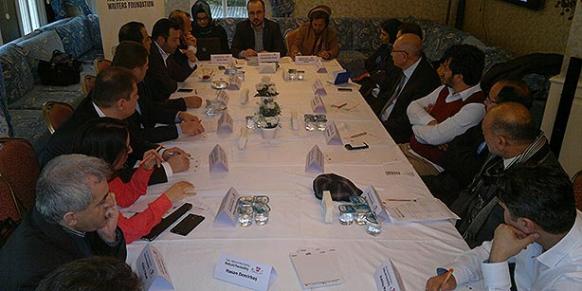
Members of the Afghan media met with colleagues for a workshop titled “Media and Peacebuilding” that was organized by the Medialog Platform of the Journalists and Writers Foundation (GYV). (Photo: Cihan)


Date posted: December 3, 2014

A group of Afghan journalists who gathered in İstanbul on Monday expressed dissatisfaction with the coverage of their country in Western media, saying they only show terrorism and violence, and the journalists argue that it is not the full picture of reality of Afghanistan.

Members of the Afghan media met with colleagues for a workshop titled “Media and Peacebuilding” that was organized by the Medialog Platform of the Journalists and Writers Foundation (GYV).

Afghan journalists acknowledged the structural problems in their country, such as limited access to the Internet and television, since about half of households still do not have electricity, but complained that Western media outlets only report on violence such as terrorist attacks and ignore other realities in Afghanistan.

Muhammad Faheem Dasthy, a journalist and a political analyst, argued that peace building through media is impractical because across the world, media outlets promote violence through their coverage.

Dasthy said that car bombs and other acts of terror are a part of their life in Afghanistan, without any doubt, but it is not the overall reality. However, when people look at their region from the Western perspective, all they see is bloodshed. Aral Azizullah joined his colleague in saying that Western media portray a negative image of their country.

A TV journalist from the Moby Group, Massood Sanjer, provided figures about the media atmosphere in Afghanistan. According to the data he provided, 58 percent of households in the country have a TV, but radio remains the main source of news for the nation. Internet penetration is still low, at just 5 percent. According to Sanjer, only 30 percent of Afghan people are “properly literate” referring to those who can understand what they read in a newspaper.

As far as media freedom is concerned, the Afghan journalists agreed that there is relative freedom in their country, despite the existence of government-sponsored media. While Dasthy argued that the media is politicized in Afghanistan and that many media outlets are dependent on political parties, another Afghan journalist Abdullah Khenjani said that compared to the rest of the region, Afghan media outlets are independent. He also argued that complete media independence does not exist anywhere in the world. According to him, independent media outlets such as his TV channel TOLO are the most influential, although no rating system exists in Afghanistan.

Providing a different part of the picture of Afghanistan, Dr. Semiha Topal from Fatih University also presented some findings from her field research on Turkish-Afghan schools and the education of girls in these schools. She noted that due to the fact that they offer a modern education that is compatible with Afghan values in these schools, the family of the former President of Afghanistan, Hamid Karzai, had asked Turkish entrepreneurs to establish a school in his hometown.

Source: Today's Zaman , December 02, 2014


Related News

Fethullah Gulen Cited among Watkins’ 2019 the Most Spiritually Influential 100 Living People

There are several factors that were taken into account when compiling the list. The person has to have made a unique and spiritual contribution on a global scale, has to be alive, is frequently googled, appears in Nielsen Data, has a Wikipedia page, and is actively talked about throughout the Internet. This list is meant to celebrate the positive influence of today’s spiritual teachers.

Zaman journalists defy threat of arrest with heads held high

Scattered across a newsroom producing Turkey’s largest-circulating newspaper, the Zaman daily, journalists from the Feza Media Group remain confident while waiting for police officers to come and handcuff them.

Abuja hosts 2016 Int’l Festival of Language and Culture

The International Festival of Language and Culture is a pioneer in the exaltation of cultural and linguistic exchange as an engine for creating and building cross-border ties of friendship.

Africa pledges further cooperation with Turkey based on mutual respect

A long-lasting partnership with Turkey that has become more visible in the African continent during the last decade is welcomed by all, since Turkish businesspeople and civil society are perceived as having been respectful of the people of Africa during the implementation of their initiatives in the continent.

Nigerian students win at global contests

Students of the Nigerian Turkish International Colleges, who represented Nigeria at the International Young Inventors Olympiads (IYIPO), have won a silver award.

Turkey’s Refugee and Asylum Seeker Policy is being debated!

The Journalists and Writers Foundation Women’s Platform, which hosts many international meetings, is organizing a workshop on “Refugee-Asylum Seeker Policy of Turkey in the Light of Recent Developments” on April 25, 2013. Refugee issue has become a hot topic in Turkey, especially with the influx of a large number of Syrian people to Turkey due […]

Latest News

Turkish inmate jailed over alleged Gülen links dies of heart attack in prison

Message of Condemnation and Condolences for Mass Shooting at Bondi Beach, Sydney

Media executive Hidayet Karaca marks 11th year in prison over alleged links to Gülen movement

ECtHR faults Turkey for convictions of 2,420 applicants over Gülen links in follow-up to 2023 judgment

New Book Exposes Erdoğan’s “Civil Death Project” Targeting the Hizmet Movement

European Human Rights Treaty Faces Legal And Political Tests

ECtHR rejects Turkey’s appeal, clearing path for retrials in Gülen-linked cases

Erdoğan’s Civil Death Project’ : The ‘politicide’ spanning more than a decade

Fethullah Gülen’s Vision and the Purpose of Hizmet

In Case You Missed It

Nigeria: Hizmet Movement not terrorists

Kimse Yok Mu reached out to 1 million people in Eid al-Adha

Ali Bulac: Gulen movement wants to participate in the globalization

Fethullah Gülen’s response to the ‘clash of civilizations’ thesis

Recruiting based on ‘color lists’ breach of Constitution

A Catholic Priest’s Letter to Fethullah Gülen

Erdogan Delivers Ultimatum: Washington Has to Choose Between Gulen and Turkey

Copyright 2026 Hizmet News