Who is Fethullah Gulen? (by National Catholic Reporter)

Date posted: July 25, 2016
Ra’fat Aldajani, Drew Christiansen
Who is Fethullah Gulen, and what is the Gulen movement? Readers of headlines and consumers of news broadcasts are likely to identify him as the alleged mastermind behind last week’s failed coup in Turkey, the archenemy of Turkish President Recep Tayyip Erdogan.
Mr. Gulen, an adept of Sufi Islam, a mystic, and an advocate of nonviolence, makes an unlikely intellectual author of last week’s coup. The high moral standards of his followers, their competence and standing in society make them natural targets for power-hungry, kleptocratic politicians.
Mr. Gulen has lived in self-imposed exile since 1999 in Pennsylvania, having fled the secularist government of that day. Now, he is attacked by Mr. Erdogan, a former ally, a one-time moderate Islamist and leader of the Justice and Development Party.
Ask millions of people educated in Gulenist schools about Mr. Gulen and you’ll hear about an inspired Muslim cleric who believes Islam does not have to turn its back on the West and Western science.
In a matter of a few decades, Gulen was responsible for modernizing Turkish education, extending it to the underdeveloped Turkish hinterland and subsequently sparking the country’s economic development. “The goal,” Jenny White, a professor of Turkish Studies at the University of Stockholm,told The New York Times, is to create a “golden generation of young people who are educated in science, but have Muslim ethics.”
If you visit the labs around MIT in Cambridge and Boston’s research hospitals, you’ll meet graduates of Gulen schools studying and doing research.
The Gulen schools were so successful that they expanded to the U.S. wherethey now number 146 schools in 26 U.S. states and the District of Columbia. In 2013 CBS’s “60 Minutes” did an extensive report on Gulenist educators brought to the U.S. to teach math to underachieving American students.
But the schools are not without their critics. They allege the Gulen schools have defrauded the government and are guilty of visa fraud in importing teachers. Many of the critics are advocates of public schools opposed to public funding of private schools. Some express nativist, anti-Muslim sentiments. Others are paid lobbyists of the Ankara government. Investigations have yet to yield formal charges.
Hizmet, the Turkish name for the Gulenist movement, means “service.” It is not an organization with a formal structure, but a loose network of businesses and nonprofit civic organizations, schools and hospitals.
Charges that the Gulenists are engaged in a conspiracy against the Turkish state is like charging graduates of Jesuit schools or of Opus Dei working in government or law enforcement of conspiring to overthrow the U.S. government.
Of course, these Catholics groups have also had had conspiracy charges made against them, but their achievements have been likewise been educational excellence, students with high moral codes and a devotion to the common good.
Outsiders may perceive Hizmet as an impenetrable conspiracy, but much of that opacity and consequent suspicion is due to the loose association of the Gulen-inspired groups. One veteran interfaith dialogist suggests their reticence may be a survival instinct resulting from suffering in decades of Levantine politics.
It is precisely because of the dispersion and independence of the many Gulen-inspired groups that it is entirely possible that some Gulenists may have been privy to last week’s attempted coup, whereas others were completely uninvolved. We do not know and cannot expect the government to present impartial evidence. So far they have produced insufficient evidence to blame the group as a whole for the coup and to pin responsibility on Fethullah Gulen himself for being its mastermind.
Erdogan’s difficulties with the Gulenists began in 2013 after popular demonstrations prevented Erdogan’s circle from seizing Istanbul’s Gezi Park, one of the city’s last green spaces, for private development.
Soon after, prosecutors brought charges against the president’s associates for corruption. Erdogan angrily dismissed both prosecutors and judges, blaming the Gulenists for trying to overthrow the government. Subsequently, he has been arresting and deposing anyone from journalists to generals who might prove an obstacle to his complete control of the Turkish state.
The dismissals, detentions and firings following the failed coup had as of July 20 reached 60,000, including 20,000 teachers and 1,500 university deans. Mr. Erdogan has also detained at least 118 generals and admirals, a third of the officers of flag rank. Twenty-four television and radio companies have had their licenses revoked for allegedly being linked to Fethullah Gulen. For similar purges we have to look back to the dictatorships of mid-twentieth century Europe or Mao’s China.
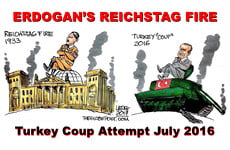
Whatever the origins of the coup attempt, Mr. Erdogan has used it to strengthen his autocratic rule. He has announced plans to resume the planned construction on Gezi Park, has proposed re-introducing the death penalty (for those he accuses of sedition) and has instituted a 3-month state of emergency.
We can expect Mr. Erdogan’s proposal for an executive presidency, rejected in a referendum in June 2015, will soon become a reality.
The West keeps searching for the model moderate Muslim leader to counter jihadist terrorism. To date, Mr. Gulen has represented that sort of leader, and Hizmet with its devotion to public service is an attractive peaceful alternative to those who may be lured to ISIS.
Had the coup in Turkey been successful it would have almost certainly plunged the country into a dangerous period of internal division and instability. But by blaming Fethullah Gulen and the Gulen movement for the coup attempt, Mr. Erdogan’s authoritarian tendencies have only increased as witnessed by the tens of thousands arrested and detained, and the radical curtailing of free speech.
It now appears that in Mr. Erdogan’s hands Turkey’s future and that of the Middle East will be less democratic, less stable and more tumultuous than ever.
[Drew Christiansen, S.J. is Distinguished Professor Ethics and Global Human Development at Georgetown University. For thirteen years he was advised the U.S. bishops’ conference on Middle Eastern affairs. Rafat Aldajani is a Palestinian-American political commentator.]
Source: National Catholic Reporter , July 25, 2016
Tags: Fethullah Gulen | Military coups in Turkey | North America | Turkey | USA |