
Accused Turkish Cleric Assails President on Anniversary of Coup Attempt in WSJ Interview
Date posted: July 15, 2017
Alan Cullison
SAYLORSBURG, Pa.—The reclusive cleric who was accused by Turkish President Recep Tayyip Erdogan of planning a coup attempt one year ago from his gated U.S. compound urged in a rare interview that the West stand up to what he called Turkey’s increasingly authoritarian leader.
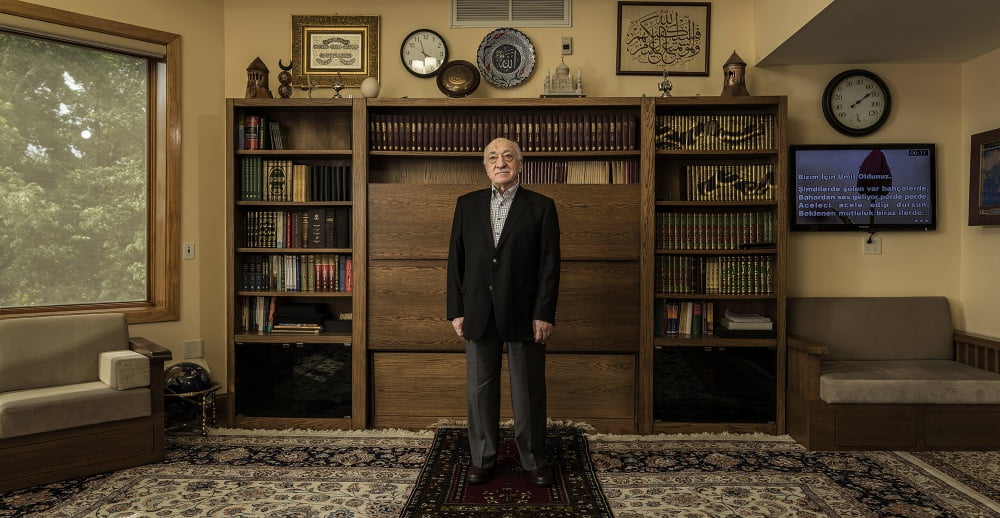
In an ornate conference room in his home in the Pocono Mountains, the cleric Fethullah Gulen repeated his declaration that he has never been involved in any coup-plotting. He decried Mr. Erdogan for launching a purge within Turkey, the brunt of which has fallen on his followers.
“I never thought that he could go so bad,” said Mr. Gulen, who said that the Turkish president was unleashing mass hysteria inside the country. “Some parts of Turkish society have lost their ability to think.”
Since last July, Turkey has arrested or driven from their jobs tens of thousands of people Turkish authorities accuse of supporting Mr. Gulen. The government has closed hospitals and schools affiliated with his social movement, Hizmet, which translates roughly as “service.”
The Turkish government said it has seized up to $4 billion in property previously owned by businessmen or foundations alleged to be linked to the movement.
“Nothing like this has been seen before in Turkey,” Mr. Gulen said. “It can only be compared with Lenin and Stalin or Saddam in Iraq.”
Turkey is now investigating 160,000 people, and 50,000 have been arrested, with 48,000 of them released, according to Turkey’s ambassador to the U.S., Serdar Kilic. There are outstanding arrest warrants for about 8,000 people, he said.
In a news conference held Friday to commemorate the first anniversary of the coup attempt, Mr. Kilic supported the country’s extended state of emergency, saying Mr. Gulen’s followers have spent decades in the ranks of government and it would take time to remove them.
Mr. Kilic continued to blame Mr. Gulen for organizing last July’s failed plot, and pressed Turkey’s demand for extradition.
He said he saw “more willingness” on the part of the Trump administration to entertain the extradition request, but that the process is “not moving as fast” as Turkey would like.
Wyn Hornbuckle, a Justice Department spokesman, declined to comment Friday, saying the Justice Department doesn’t speak publicly about extradition requests.
“I believe that there are certain measures that the U.S. authorities can take,” Mr. Kilic said, “including limitations on his activities in the United States. He’s still freely giving interviews to newspapers. This is not freedom of expression, he’s accusing the Turkish government, he’s sending messages to his supporters in Turkey and he is still traveling.”
Mr. Gulen said that his movement is also coming under pressure outside of Turkey as Ankara tries to persuade countries to shut down his movement’s schools in other countries. Many governments have refused, his aides said, but others have been currying favor with Ankara by shutting down schools and transferring property to the Turkish government.
Mr. Gulen described what he called rising chauvinism and racism in Turkey—as well as Europe and the U.S.—but said traditional institutions weren’t addressing them head on. “NATO has a potential, the European Parliament has a potential,” he said. “But in their current state they don’t seem to be addressing these problems right now.”
On July 15, 2016, mutinous elements of the Turkish military took to the streets, tanks opened fire on civilians and jet fighters bombed parliament as part of the unsuccessful coup attempt, during which commandos also made a botched effort to catch or kill the Turkish president. More than 240 people died in the violence.
The Turkish government alleges that Mr. Gulen’s followers in his homeland have been plotting for years to take over the state through powerful positions in the military and judiciary and across the civil service. Authorities in Ankara liken him to a cult leader.
Mr. Gulen, who has been a resident of the U.S. since 1999, said he supports a modern and moderate version of Islam that supports democracy, science and tolerance.
His presence in the U.S. was an early quandary for President Donald Trump, who sought closer relations with Turkey and whose former national security adviser, Mike Flynn, had performed lobbying work on behalf of the Turkish government.
Aides to Mr. Gulen said they think any extradition to Turkey is less likely after the resignation of Mr. Flynn, who had failed to disclose the extent of his contacts with foreign officials.
In the interview, Mr. Gulen said that the Turkish president’s authoritarian streak was on display during his visit to Washington earlier this year, when Mr. Erdogan’s personal bodyguards attacked protesters outside the Turkish Embassy. Federal prosecutors in the U.S. later filed charges against at least 10 members of the detail.
“They are not like guards, they are like assassins who are so devoted to their leader that they will not refrain from shooting people,” he said.
The Turkish Embassy said at the time that the Erdogan supporters were responding in self-defense to terrorist sympathizers.
Mr. Gulen—a powerful orator known as the Hocaefendi, or respected teacher, by his followers—has written numerous books and delivered emotional video speeches.
His group, formed at a time when Turks feared religious persecution by a secular government, has often been cagey about its membership, contributing to allegations that he in fact was running a secret cult.
Graham Fuller, former vice chairman of the U.S. National Intelligence Council who has defended Mr. Gulen’s movement as a positive force for moderate Islam in today’s world, said the allegation is no longer deserved. “Over the last decade or more it has had a very public face,” he said.
In Turkey, Gulenists have spread throughout state institutions such as the courts and the military “to ensure these institutions would not be used against them again,” said Mr. Fuller, who in 2006 wrote a letter to the FBI defending Mr. Gulen against attempts to extradite him.
Source: Wall Street Journal , July 14, 2017
Tags: Military coups in Turkey | Persecution of Hizmet by Erdogan | Turkey |


