
Dr. Ergil answers 100 questions about Fethullah Gülen and his movement
Date posted: November 10, 2010
MURAT TOKAY
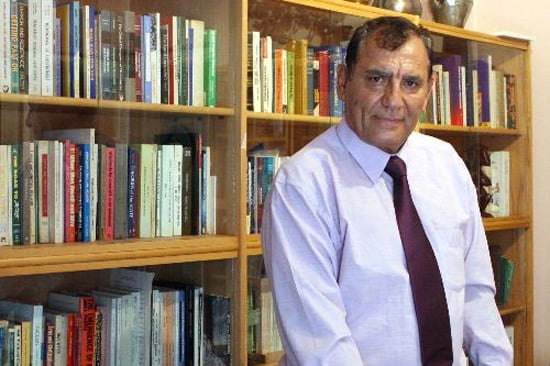
Professor Doğu Ergil, a distinguished political scientist, has completed his two-and-a-half-year study on the volunteer movement inspired by Fethullah Gülen, a preacher, prolific writer and advocate of interfaith and intercultural dialogue.
Titled “100 Soruda Fethullah Gülen ve Hareketi” (Fethullah Gülen and His Movement in 100 Questions) (Timaş Publishing House), Ergil’s book dissects the movement from a social science perspective and based on the answers Gülen gave.
“Fethullah Gülen seeks a Turkish renaissance. … The Gülen movement is currently Turkey’s most important export asset. … The key to the success of the Gülen movement is that they believe in their cause.” These observations are Professor Ergil’s. He has been studying the Gülen movement for about two-and-half years, and he has compiled the common questions about the community and his analysis of it in his book. Ergil is a lecturer at the faculty of political science at Ankara University, and he prepared the controversial Kurdish Report in 1995.
Explaining what motivated him to study the volunteer movement inspired by the views and ideas of Gülen, Professor Ergil draws attention to the fact that the phenomenon of people’s “forming communities” has gone international. “So far this phenomenon has not been analyzed from a sociological perspective that goes beyond the daily political conflicts and worries or doubts that lay their groundwork. Someone, particularly from the ‘secular camp,’ had to do something about it,” he says.
The idea of writing such a book occurred to him when he was visiting Gülen at his Pennsylvania residence three years ago. “I asked him whether he would be willing to answer some of my questions about the movement he inspired if I started to work on the sort of ‘100 Questions’ book with which Turkish readers are familiar. ‘Of course I will,’ he replied. So I prepared a list of 100 questions and presented it to him.”
Ergil met with Gülen twice while writing the book. The 100 questions Ergil asked consist of those the general public is curious about. Ergil’s analysis accompanies Gülen’s answers to these questions.
You will also find assessments by Ergil at both the beginning and end of the book. In a chapter titled “The religious leader phenomenon in modernizing Turkey: the case of Fethullah Gülen,” Ergil says: “What is the secret to the Gülen movement’s success? You will find the answer to this question in this book that comprises a sociological analysis of Gülen’s answers to these questions and his previously published statements.” In the last section of the book, the movement is discussed from a historical perspective. It is in this section that Ergil draws parallels between Ahilik, or the tradition of trade guilds, and the movement.
The book begins with the question, “Who is Fethullah Gülen?” Other questions include: Is the Gülen movement an extension of a previous movement? What are the tenets of the Gülen movement? What is the place of the state in the thought of Fethullah Gülen? Which individual and social needs does it satisfy to the extent that it has spread throughout the entire country, even spreading beyond the country’s borders in a short time? Some argue that the Gülen movement is an organization that seeks to be an alternative to the state; is this really the case? Does Gülen have an ideal model of society in his mind? Who is the Gülen movement’s target audience? What are the movement’s financial resources?
There is no success that goes unpunished in Turkey!
As you were working on Gülen and the movement inspired by him, were there things that surprised you?
Several. Observing how a civil society organization can grow so powerful and evolve into a global phenomenon. As people who tend to expect support from the state for every initiative, we have difficulty understanding how our own people can create a national, and then international, movement, all from their own resources. Then we find out that we do not like the weakness with which we imprison ourselves. We nurture doubts and worries about the people who combine their resources to create a strong movement. Actually, we are not blaming them but ourselves and our “adopted helplessness.”
It is a contradiction for us to try to attribute the opposite to a movement which takes pains not to be in conflict with the state and which does not demand anything from it and which categorically refrains from taking part in politics.
It is extraordinary that an imam from rural Anatolia has emerged to become an opinion leader who influences large social groups and leads them in their search for modernization, improving their quality of life and secularization.
To interpret wealth as a reward from God to the people for their hard work and for being useful to others, something that paves the way for the accumulation of capital and encourages the businessmen to turn into investors.
To ensure that religion and science go together and that science penetrates not only individual lives, but also social life. To create educational institutions on an international scale and take them everywhere.
To understand that while many religious communities or clerics derive justifications for violence and hatred from the Quran and hadith, Gülen can spread peace, solidarity and all-inclusive common values, and he exerts great humane efforts to this end, accompanied by the impressive accomplishment of his followers to spread his efforts.
To observe that the Gülen movement has achieved secularization from the bottom up, contrary to the previous efforts by state authorities to achieve it. To see that with an increase in their welfare, education and effectiveness, people can make more rational decisions and experience the coexistence of religion and science, or life on Earth and the Hereafter, without separating or compartmentalizing them in their daily lives. This has happened without political choice or compulsion, but as a sociological and cultural process.
What do you think about recent efforts to create an atmosphere of fear around Gülen?
Well, it is easy to fear a movement which has achieved so many things and whose dynamism and influence are increasing. This is particularly so if you cannot create the capacity, skills or solidarity to neutralize its so-called harmful effects. As the saying goes, “There is no success that goes unpunished in Turkey!”
‘The Gülen movement is Turkey’s greatest export asset’
Why did you decide to write this book? What were the factors that drove you to action?
There are three factors that urged me to write this book: First, we know so little about a person who is frequently referenced in many discussions, but who does not hold a defined position or an official capacity. The rumors circulating about him were not based on serious studies or the articles about him were mostly written from inside the community. Filling this gap was a real challenge for a social scientist. Second, it was the first time that we witnessed such a civil society organization in Turkish society, which is historically dominated by the state, and we had virtually no concrete knowledge about how it came into being and how it evolved. Finally, the Gülen movement has been Turkey’s greatest export asset, and we have never seen a nongovernmental organization which could open itself to the world without any support from the state and which could ensure its sustainability. Instead of trying to find answers to the questions about how this happened, we were resorting to rumors. Someone, particularly from the “secular camp,” had to do something about it.
Did you meet Gülen?
Yes, twice, at his residence in northern Pennsylvania.
What were your criteria in selecting the 100 questions?
These questions were all about the things society was curious about or about which we lack sufficient knowledge. I wanted all the questions and doubts under the sun to be answered.
How did you find the answers to these questions? What was the methodology you employed?
I resorted to two main resources. The first one was Gülen directly. When I was visiting Gülen three years ago, I asked him whether he would be willing to answer some of my questions about the movement he inspired if I started to work on the sort of “100 Questions” book with which Turkish readers are familiar. “Of course I will,” he replied. So I prepared a list of 100 questions and presented it to him. Also, I had a chance to have lengthy conversations during my three-day and two-day visits with him.
Did Gülen reply verbally to your questions?
He gave both verbal and written replies to my questions. An important part of the written replies consists of his writings and texts of the information he provided to other people. These texts are endorsed by Gülen. The rest is the outcome of our conversations. I was loyal to the texts given to me and I indicated the references. Still, the excerpts were shaped by my own understanding.
How much time did you invest in this book?
I started to work on it about two-and-half years ago.
From the book…
Said Nursi and the Risale-i Nur Collection, a 6,000-page commentary on the Quran, have had a significant impact on Gülen and the movement he inspired. This impact seems to be largely spiritual and inspirational.
The Gülen movement has its unique praxis, which largely rests on today’s conditions.
Gülen has dedicated his life to the understanding and interpretation of the principles of religion and the sharing of the lessons he personally learned with other people. This perspective should never be overlooked in order to understand what he says and does.
A call similar to that of Mevlana’s is today being voiced by the Gülen movement. There is absolute consistency between what is preached and what is performed, and this creates an unshakable bond between the spiritual leader and his followers.
Is there any other civil society organization that can represent Turkey’s impact, culture and human relations to the outside world as comprehensively and effectively as this movement? No! Unfortunately, there are none. So how can the Gülen movement achieve this? With belief? In what? In their cause and by believing that they do service to God and God’s servants in this way.
The fact that it is defined not only as a “community” but also as a “movement” can only be explained by the Gülen movement’s spatial and operational mobility that goes beyond typical communities’ local nature and “subsidiarity.”
The movement was able to develop and grow — in the face of pressure — and this can be explained by the fact that the people from different groups see certain benefits in the proposals and suggestions of Gülen and they can experience the beneficial outcomes of them in their own lives. Like Ahilik, the Gülen movement is a movement of the periphery. Its efforts serve to ensure the joining of those groups peripheral to the center. This not only helps the groups which may potentially be against the center (the system) integrate with it, thereby transforming them to allow for greater pluralism, it also adds new dynamism to the system.
Source: Today's Zaman , 30 May 2010
Tags: Hizmet (Gulen) movement | Interviews on Fethullah Gulen |


