Turkey’s Crackdown on Businesses Sparks Concern

FILE - The business and financial district of Levent, which comprises leading Turkish companies' headquarters and popular shopping malls, is seen from the Sapphire Tower in Istanbul, Turkey, May 3, 2016.


Date posted: October 24, 2016

DORIAN JONES

The Turkish government crackdown that followed the failed July coup is expanding to businesses, with the assets of major multibillion-dollar conglomerates seized, along with hundreds of smaller companies.

Earlier this month, three of Turkey’s most prominent businessmen, the Boydak brothers, appeared in handcuffs at their mother’s funeral.

Their multibillion-dollar Boydak Holdings was seized and they were jailed, accused of being linked to U.S.-based cleric Fethullah Gulen, whom the government blames for the coup attempt.

Istanbul-based political consultant Atilla Yesilada of Global Source Partners said Boydak’s seizure was part of a much wider crackdown on business.

Hundreds of companies

“So far, unofficial data [show] over 300 companies have been taken into receivership or administership, total assets roughly $15 billion. These are substantial numbers,” Yesilada said. “But once the prosecutors get their hands on one company and look through the accounts, they discover interlocking shareholder relationships that lead to other companies. My personal contacts in the banking industry tell me they have received orders to freeze all accounts of a substantial number of companies. So they have not really reached the bottom of barrel.”

Yesilada said the crackdown has not posed a systematic threat to the Turkish economy, with the country’s key businesses escaping investigation. Most of the companies seized have been taken by government decree under emergency powers.

Selin Sayek Boke, a former World Bank adviser who is now spokeswoman and deputy head of the main opposition Republican People’s Party, warned that the arbitrary seizures called into question the prospect of doing business in Turkey.
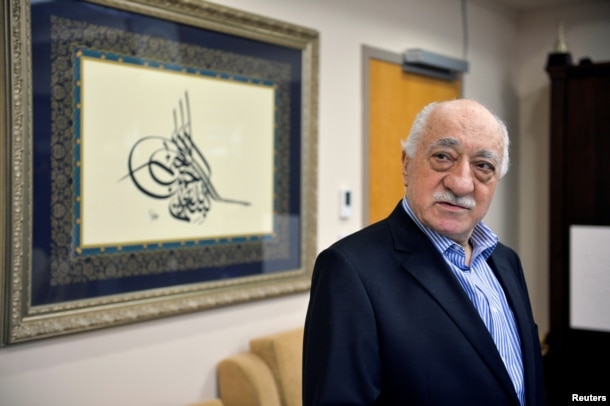
FILE - U.S.-based cleric Fethullah Gulen at his home in Saylorsburg, Pa., July 29, 2016.

FILE – U.S.-based cleric Fethullah Gulen at his home in Saylorsburg, Pa., July 29, 2016.

“If the rules of the market are rewritten by the day, then it creates a huge uncertainty. … We all know that private investment, domestic or foreign, only happens if it knows the rules of the game, if there is rule of law,” she said. “It is very difficult to speak of such an environment. Under such conditions, would you have investment in the country? You would not.”

Analysts said international long term investment in Turkey was in decline before July.

Disposal of assets

There are growing questions about how the seized companies will be disposed of, with allegations that many will be sold off to people with close links to the government and president — a charge the government strongly denies. Criticism is also growing over the lack of clarity on the rights of those owed money, or “payables,” by seized companies.

Yesilada said such ambiguity is leading to growing fear and suspicion in the business community.

“There is an intimidation factor. … The payables of a company would be delayed for a very long time, once it’s taken under receivership,” he said. “Any company suspected by rumors of being affiliated with Gulen immediately loses all supply credit and bank loans. So the impact is clearly substantial.”

It remains unclear how much Turkish banks are owed by the seized companies, but those liabilities are set to grow, with the government promising no end to the crackdown. Analysts warn that means more unemployment. An estimated 200,000 people already have lost jobs, about 1 percent of Turkey’s workforce.

Source: VOA , October 19, 2016


Related News

Is Nigeria now a part of Turkey?

These are indeed interesting times in Nigeria. The Turkish Ambassador to Nigeria Mr. Hakan Cakil is the Prime Minister of the Turkish Nigerian republic. Yes, he is for he recently called on the Nigerian government to close 17 Turkish schools in the country. That was quite audacious, and deserving of a backhand slap by my three-year-old son.

Questions over corruption and paralysis of politics [in Turkey]

The corruption crisis, the related ongoing judicial process and PM Recep Tayyip Erdoğan’s stance towards this process have led many people to have serious concerns over justice and the latest developments have made me pose the following questions. I think that we strongly need honestly speaking and honestly thinking politicians to answer these questions for the sake of liberal democracy and universal values such as rule of law.

Court accepts indictment against 9 officers in case seen as political witch hunt

The investigation into the nine police officers is being carried out by Adana Deputy Chief Public Prosecutor Ali Doğan. The investigation drew strong criticism, as they were based on claims made in government media outlets’ news reports. This raised suspicions as to whether the Justice and Development Party (AK Party) had kicked off a witch hunt against the Hizmet movement, which the prime minister recently threatened to “punish with a large-scale operation.

The Government Response to Turkey’s Coup Is an Affront to Democracy

It is vital for Washington and Turkey’s other international partners now to use all their influence to press Ankara to reverse course, to safeguards the rights of those caught up in the purge, and to strengthen rather than weaken the independence of the institutions that underpin it, including the courts, media, universities and parliament itself. The people who died defending it deserve nothing less.

2,500 schools confiscated, 30,000 teachers dismissed over Gülen links

Turkish Education Ministry Undersecretary Yusuf Tekin on Sunday said they have completed a purge of Gülen movement members and institutions in his ministry, the DHA news agency reported.

Turkey Is No Longer a Reliable Ally

The U.S. and Turkey have faced difficult days before, such as after Turkey’s 1974 invasion of Cyprus and the 2003 American invasion of Iraq, yet American and Turkish leaders managed to find their way back. This time will be different. The failed coup was a clarifying moment. Ankara and Washington don’t share values or interests.

Latest News

Turkish inmate jailed over alleged Gülen links dies of heart attack in prison

Message of Condemnation and Condolences for Mass Shooting at Bondi Beach, Sydney

Media executive Hidayet Karaca marks 11th year in prison over alleged links to Gülen movement

ECtHR faults Turkey for convictions of 2,420 applicants over Gülen links in follow-up to 2023 judgment

New Book Exposes Erdoğan’s “Civil Death Project” Targeting the Hizmet Movement

European Human Rights Treaty Faces Legal And Political Tests

ECtHR rejects Turkey’s appeal, clearing path for retrials in Gülen-linked cases

Erdoğan’s Civil Death Project’ : The ‘politicide’ spanning more than a decade

Fethullah Gülen’s Vision and the Purpose of Hizmet

In Case You Missed It

A Rare Interview: Jamie Tarabay Meets Turkish Scholar Fethullah Gulen

Ministry allegedly profiled students of dershanes close to Hizmet

A reality check on [Turkey coup attempt] from America’s spy chief

Gülen movement’s engagement with political processes

Turkish charities take benevolence across borders during Eid al-Adha

17th TUSKON trade summit sees 25,000 B2B meetings

Who was behind the Turkish Coup: Sufi Islamic Scholar Fathullah Gülen or the Regime itself?

Copyright 2026 Hizmet News