Turkish Schools Discussed at Johns Hopkins University
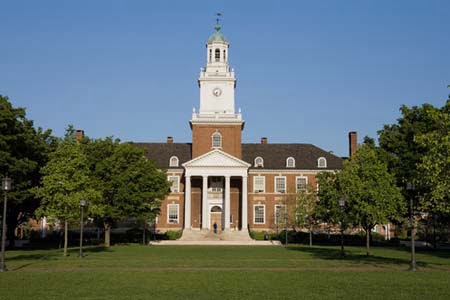
Johns Hopkins University


Date posted: October 26, 2004

In a conference at the Central Asia-Caucasus Institute (CACI) at the Johns Hopkins University, Turkish schools in Central Asia were closely analyzed.

In a conference titled ‘Turkish way of Islam Educates Central Asians’, which Dr. Bayram Balci from the French Institute of Anatolian Studies in Istanbul attended as lecturer, the educational movement initiated by Fethullah Gulen and its activities in the region were discussed.

Speaking in the conference, which was opened by the director of the Institute, Professor Charles Fairbanks who is also recognized as one of the authorities on Central Asia, Dr. Balci expressed that he finds the schools ‘very successful’. Balci, who researched the region and Turkish schools there between 1996 and 1999 for the French Grenoble University, submitted his studies as a dissertation which has been published as a book in France. According to Balci, schools in countries like Kazakhstan, Uzbekistan, Kyrgyzstan, Tajikistan, Turkmenistan, Azerbaijan, and Georgia are magnets for people as well as the elites of the region due to their high rates of success in student matriculation in the university entrance exams, as well as the prizes they win in the Science Olympics. The underlying factors for this achievement are listed as: modern education and equipment; highly motivated teachers; a dormitory system; weakness of local education; the absence of corruption.

Indicating that the schools were admired by both Turkish diplomatic representatives in the related countries and the local administrations, Balci announced that in these schools education in positive sciences is in English, Turkish, Russian, and local languages and the curriculum is secular. Which prompts the question of where Islam stands in these schools. Balci said: “The first principle of the schools is not to convert people to Islam, but to turn them into qualified people.” He went on to say that students are educated as decent and patriotic individuals and added that the religious activities should be evaluated within the framework of the moderate ‘Turkish way of Islam’.

Source: Today’s Zaman, 25 October, 2004

Tags: USA, Turkish schools


Related News

Parents dream of their children being admitted to Turkish schools in Senegal

Senegalese Media Owners Association Chair Madiambal Diagne says that the Turks should also be appreciated because of their approach toward education. “The best way to help people in another country like ours is to extend support in the field of education. The people who receive this educational support become industrious and decent and do their job properly.

Ankara’s soft-power dilemma

Turkey’s major assets in terms of successful diplomacy and soft-power policy included Turkish schools opened by the Hizmet movement all around the world; the International Turkish Language Olympiads organized by the same group; business associations within and outside the borders of Turkey; intercultural and interfaith dialogue societies; foreign language publications of Turkish society; Turkish hospitals in several countries; and Turkish international humanitarian aid organizations.

Building bridges while breaking bread: Norfolk temple holds interfaith Ramadan meal

Exiled. Away from his friends and family and watching from afar as thousands of Turkish doctors, teachers, professors and more have been jailed. Unbelievable, Bilici called it. Out of work and afraid of what was coming, he left the country. Eventually, he purchased a one-way ticket to America and is now, like thousands before him, a Muslim immigrant.

Editorial: Expulsion of Turk Teachers from Pakistan

The point is that Turkish teachers have not committed any crime in Pakistan. Abrupt exodus of those teachers would destroy teaching system in Pak-Turk schools in Pakistan. Nawaz Sharif should have considered the interest of citizens of Pakistan before submitting to unfair requests of Turkish government.

Turkish Repression Targets Americans

It’s an old story with dictators. If unopposed, they become ever more brazen in their aggression. Case in point: Turkey’s Recep Tayyip Erdoğan. On May 16, during a state visit to Washington, Erdoğan’s bodyguards beat up peaceful protesters, many of them American citizens, in front of the Turkish embassy. At least 11 protesters were injured.

An NBA Center Faces Imprisonment And Possible Execution In Turkey

Normally, the Oklahoma City Thunder would be trying to find a replacement for Kevin Durant, or figure out how to get past the Golden State Warriors, San Antonio Spurs or Houston Rockets. They probably didn’t expect they’d have to struggle to keep their center Enes Kanter from being jailed and possibly executed in Turkey by an increasingly authoritarian leader.

Latest News

Turkish inmate jailed over alleged Gülen links dies of heart attack in prison

Message of Condemnation and Condolences for Mass Shooting at Bondi Beach, Sydney

Media executive Hidayet Karaca marks 11th year in prison over alleged links to Gülen movement

ECtHR faults Turkey for convictions of 2,420 applicants over Gülen links in follow-up to 2023 judgment

New Book Exposes Erdoğan’s “Civil Death Project” Targeting the Hizmet Movement

European Human Rights Treaty Faces Legal And Political Tests

ECtHR rejects Turkey’s appeal, clearing path for retrials in Gülen-linked cases

Erdoğan’s Civil Death Project’ : The ‘politicide’ spanning more than a decade

Fethullah Gülen’s Vision and the Purpose of Hizmet

In Case You Missed It

Turkey is gateway to Europe: exporters urged to collaborate with Turkish companies

EastWest Institute honors Gülen with 2011 EWI Peace Building Award

More Divisions, More Democracy

The Gulen Movement has become Turkey’s most significant export

Hate Speech is Undermining Turkey’s Fragile Democracy

Kimse Yok Mu establishes town in Pakistan

Erdoğan confesses anti-Gülen witch-hunt has gone off track

Copyright 2026 Hizmet News