
Keyword: Persecution of Hizmet by Erdogan
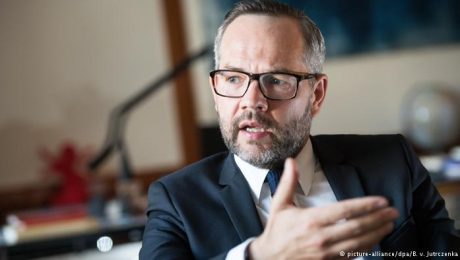
German state minister: Persecuted Turks can apply for asylum in Germany
“Germany is an outward-looking country and is open to all those who are politically persecuted as a matter of principle,” Roth said. “They can apply for asylum in Germany. That applies not just to journalists.” Roth also spoke out against Turkish President Recep Tayyip Erdogan’s crackdown against opposition lawmakers and critical journalists and academics.

Turkey’s ‘Nazi-style’ purge of academia condemned
The mass sacking of more than 1,200 academics in Turkey has been compared to tactics used in Nazi Germany. Jean Asselborn, Luxembourg’s foreign minister, made his comments shortly after Turkish authorities released a list of 1,273 academics fired from public universities on 29 October.

Turkey’s treatment of dismissed officials reminiscent of Nazis: Luxembourg
Luxembourg’s foreign minister said on Monday that the Turkish government’s handling of civil servants dismissed after a failed coup attempt reminded him of methods used by the Nazis, and that sooner or later the EU would have to respond with sanctions.

After The Coup Attempt, A Crackdown In Turkey
Once considered a beacon of hope for the Middle East, Turkey has been rapidly backsliding on issues of democracy, freedom of the press, and human rights. One would have thought this downfall hit bottom on July 15, when a bloody coup was attempted, leaving behind more than 250 dead.

Report: Turkey’s purge risks isolating its higher education from int’l academia
Turkey’s purge of academics has already harmed the reputation of its higher education sector, the latest Free to Think report from the New York-based Scholars at Risk (SAR) noted adding that it risks greater damage by isolating Turkish scholars, students, and institutions from the international flow of ideas and talent.

Former Daimler chairman: Turkey’s purge reminds of me beginning of Nazi era
Edzard Reuter, the son of the first mayor of West Berlin Ernst Reuter and the former chairman of the German automaker Daimler-Benz, said Turkey’s post-coup purge recalls what happened during early years of Nazi regime at his home country.

In Erdogan regime western-oriented intellectuals, bureaucrats, liberals, Kurds, civil society activists in mortal danger
Those in prison—educated, Western-oriented intellectuals and bureaucrats, liberals, Kurds, civil society activists, and supporters of exiled cleric Fethullah Gülen—are in mortal danger. When blood flows from the prisons, it will be no accident nor should anyone believe Erdogan’s security forces were simply reacting to a crisis.

Turkish business suffers under Erdogan’s post-coup Gulen purge
Critics of the ruling AKP expect it to sell Gulen-linked companies to government allies in the business world at a large discount. In mid-October the AKP-linked Metro Holding applied to the TMSF to acquire all of Koza Ipek Holding’s shares. Akin Ipek, the fugitive former owner of the conglomerate, asked on Twitter how Koza Ipek’s $600 million in cash and $20 billion in mining assets could be acquired by a comparatively unimpressive entity. Metro Holding’s capital comes to just over $95 million.

What Is Next In Turkey?
The generals were never the script writers of the coups but only players. The script writers of the coup on July 15 in Turkey aimed to simulate a coup as if it was staged by the Gulen movement. It was simply a false flag. While only a few hundred soldiers were involved in the coup, more than ten thousand officers were purged and arrested. While the police officers challenged the coup plotters, twelve thousand police officers were fired two months after the coup.

Turkish gov’t planning slaughter of jailed Gülen followers in staged riot, lawyer claims
The Turkish government is headed for mass killings of people jailed over alleged or real links to the Gülen movement, in a staged riot in Silivri prison, a lawyer representing a former police chief imprisoned as part of a crackdown against the movement claimed, underlining that he is worried about the lives of his clients.

Five global challenges: how might Hizmet respond?
Hizmet, the social movement inspired by the neo-Sufi thinker Fetullah Gülen, is currently being dismembered by the autocratic president of Turkey, Recep Tayyip Erdogan. He accuses Gülen of ordering a coup attempt on 15th July 2016, saying it was was led by Hizmet members in the army.


Calgarian held in Turkish prison granted a lawyer but confined to solitary
Calgary-based Imam Davud Hanci was arrested on allegations that he was the mastermind behind a failed coup attempt in July to remove Turkish President Recep Erdogan from power — allegations Hanci’s family called “ridiculous.”


