Turkish gov’t detains more than 70 women over their alleged financial support for jailed Gülen followers

Date posted: March 28, 2018

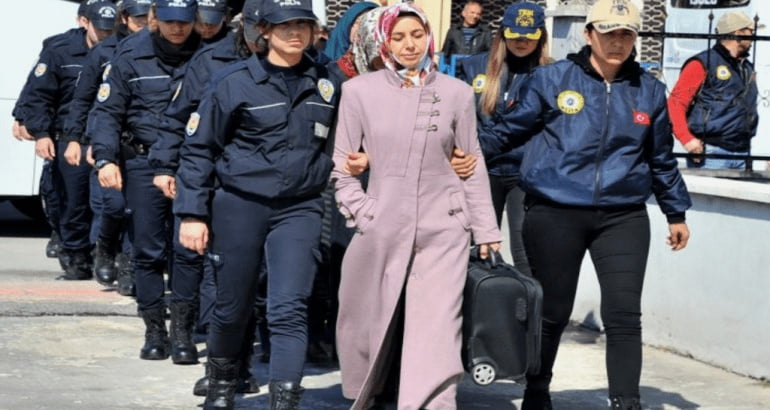
The Turkish government detained more than 70 women on Wednesday evening in five provinces across Turkey as part of a Balıkesir-based investigation targeting alleged members of the Gülen movement.

According to a report by online news outlet Kronos, 600 police officers took part in the operations led by Balıkesir Police Director Cengiz Zeybek and conducted raids to the 63 addresses in İzmir, Manisa, Uşak, Denizli and Balıkesir provinces. Police detained more than 70 women over their alleged links to the Gülen movement during the raids.

It was claimed that the detained women have been helping financially to the relatives of those who were jailed or escaped from the persecution of the Turkish government over their alleged links to the movement. The detained women were allegedly visiting frequently the families of the victims of the Turkish government led by autocratic President Recep Tayyip Erdoğan which has conducted a massive post-coup witch hunt campaign against the alleged members of the Gülen movement.

On Tuesday, at least 13 women were also detained by police over their alleged ties to the Gülen movement in a Karaman-based investigation. According to reports in Turkish media, Karaman Chief Prosecutor’s Office issued detention warrants for 18 women over their participation in the Gülen movement’s activities on March 22. Police carried out operations in 11 provinces and have detained 13 of them so far, according to media reports on Tuesday. Out of those 13 detained, 5 were later released on judicial control.

Women who have been jailed in an unprecedented crackdown have been subjected to torture and ill-treatment in detention centers and prisons as part of the government’s systematic campaign of intimidation and persecution of critics and opponents, a report titled “Jailing Women In Turkey: Systematic Campaign of Persecution and Fear released in April 2017 by SCF revealed.

In several cases, women were detained in the hospital immediately after the delivery of a baby and before they had a chance to recover. Many women were jailed as they were visiting their imprisoned husbands, leaving the children stranded in the ensuing chaos.

Turkey survived a controversial military coup attempt on July 15, 2016 that killed 249 people. Immediately after the putsch, the Justice and Development Party (AKP) government along with autocratic President Recep Tayyip Erdoğan pinned the blame on the Gülen movement.

Fethullah Gülen, who inspired the movement, strongly denied having any role in the failed coup and called for an international investigation into it, but President Erdoğan — calling the coup attempt “a gift from God” — and the government initiated a widespread purge aimed at cleansing sympathizers of the movement from within state institutions, dehumanizing its popular figures and putting them in custody.

Turkey has suspended or dismissed more than 150,000 judges, teachers, police and other civil servants since July 2016. Turkey’s interior minister announced on December 12, 2017 that 55,665 people have been arrested. On December 13, the Justice Ministry announced that 169,013 people have been the subject of legal proceedings on coup charges since the failed coup.

A total of 48,305 people were arrested by courts across Turkey in 2017 over their alleged links to the Gülen movement, Interior Minister Süleyman Soylu said on Dec. 2, 2017. “The number of detentions is nearly three times higher,” Soylu told a security meeting in İstanbul and claimed that “even these figures are not enough to reveal the severity of the issue.”


Source: Stockholm Center for Freedom , Marh 29, 2018


Related News

The Gülen Movement and Turkish Soft Power*

The Gülen approach to education aptly demonstrates the group’s global strategy—Gülen movement schools are open to both Turkish migrants and citizens of host countries, and they avoid advancing a religious agenda. These schools aim to help Turkish migrants succeed in their host societies without losing sight of their Turkish roots, and at the same time they promote social unity by serving the needs of migrants and local students alike. The success of Gülen movement schools stems both from the success of the students (and the satisfaction of the parents) and from the prestige and goodwill they enjoy among local and political authorities for promoting integration and acting as a social mediator.

Gülen extends condolences for death of former deputy PM Arınç’s brother

Turkish Islamic scholar Fethullah Gülen, who inspired the faith-based Hizmet movement, has offered condolences to former Deputy Prime Minister Bülent Arınç, whose elder brother, Yıldıray Arınç, was laid to rest on Tuesday.

21st century Pharaoh rises: The tragedy of Turkey’s failed coup

Recep Tayyip Erdogan, even before the coup occurred, has been seen as a dictator who has constantly sought to crackdown on his opponents, and consolidate his power within the country. Turkey has one of the worst freedoms of expression record globally, with tons of journalists imprisoned for criticizing the Turkish Government.

This is too much! [About the Lies and Slanders directed to Gulen movement]

Prime minister said during the fourth ordinary general meeting of the Turkish Confederation of Businessmen and Industrialists (TUSKON) in March of 2012:
“You are not backed by dark forces. You are not backed by the mafia, gangs, junta regimes. You are not backed by the bankers in Galata. You did not take advantage of the sources of the Treasury or public banks. You did not act according to an ideology. You did not surrender to the pressures and roadblocks. You only trusted in the people. Because you only relied on people, you are great and make this country great.”

Countdown for operation against Hizmet Movement

Even though the government has already removed from duty thousands of people, including police officers and members of the judiciary, it would have difficulties persuading “civil servants” to launch an operation against the community [Hizmet movement].

Hizmet in Context: Societal Islam Versus Political Islam

The Hizmet movement is according to Ebaugh (2010) a civic movement rooted in Islam that is independent from the state. Others see it simply as a faith- based movement (Esposito and Yilmaz 2010). Agai (2004) describes it as an education network and Hendrick (2009) as a global pressure group to promote Turkish interests.

Latest News

Turkish inmate jailed over alleged Gülen links dies of heart attack in prison

Message of Condemnation and Condolences for Mass Shooting at Bondi Beach, Sydney

Media executive Hidayet Karaca marks 11th year in prison over alleged links to Gülen movement

ECtHR faults Turkey for convictions of 2,420 applicants over Gülen links in follow-up to 2023 judgment

New Book Exposes Erdoğan’s “Civil Death Project” Targeting the Hizmet Movement

European Human Rights Treaty Faces Legal And Political Tests

ECtHR rejects Turkey’s appeal, clearing path for retrials in Gülen-linked cases

Erdoğan’s Civil Death Project’ : The ‘politicide’ spanning more than a decade

Fethullah Gülen’s Vision and the Purpose of Hizmet

In Case You Missed It

Remarks by Congressman Randy Weber (Representing Texas) at IFLC Washington DC

British politician Duff: So easy for some Turkish media to misreport

Turkish delegation visits Crimea Simferopol International School

GYV President meets Minister of Gender Equality and Family of the Republic of Korea

Bruised by lavish palace, Erdoğan pictures fake Gülen compound

Interview with Kimse Yok Mu Foundation’s President Ismail Cingoz

Turkish gov’t jailed not only journalist Karaca, but also his lawyers and the judges who ruled to release him

Copyright 2026 Hizmet News