New Jersey’s Peace Islands Institute Holds Iftar At Community Center
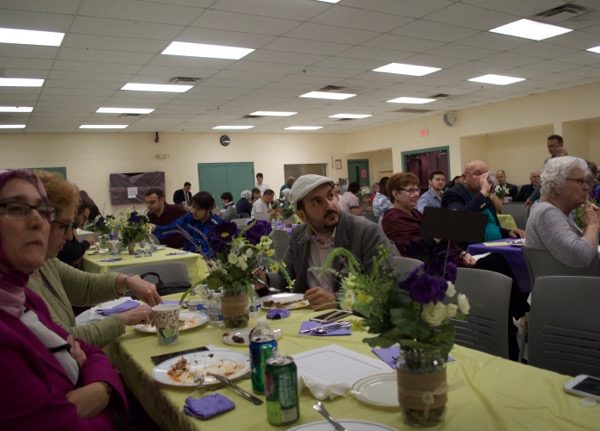
About 100 people attended Peace Islands Institute’s third annual Iftar at the township Community/Senior Center June 17.


Date posted: June 19, 2017

The practice of fasting in religions other than Islam was explored June 17 during a Ramadan Iftar held at the township Community/Senior Center in the Municipal Complex.

An Iftar is the breaking of the daily fast during the Muslim’s month-long observance of Ramadan.

Speakers representing Judaism and Christianity spoke about fasting in their faith traditions during the event, which was sponsored by the Hasbrouck Heights-based Peace Islands Institute.

Anna West Zott, cantor of Anshe Emeth Memorial Temple in New Brunswick, told the roughly 100 attendees that Judaism observes six “statutory” fasting periods, which are used “as a means of purification and atonement, with the goal of leading Jews to more ethical behavior.”

Fasting in general, she said, “is an opportunity to cleanse ourselves, to purge ourselves of impure or unethical thoughts, then we can return to regular life ready to take it on anew.”

The Rev. Hartmut Kramer-Mills, of the First Reformed Church in New Brunswick, told attendees that his denomination, Reformed Protestantism, does not have a tradition of fasting, “but some of us do fast anyway.”

Kramer-Mills said that rather than engage in fasting, Reformed Protestanism’s founder, John Calvin, developed other means of “restraining ourselves.”

“Sometimes the opposition against fasting and other practices of the established Church became rather rebellious,” he said.

The earliest example came in the 16th Century, he said, when scholars rejected the Biblical translations of the Catholic Church and created their own. This resulted in a ban on creating “idols” of any kind, including religious statues, he said.

Later, Calvin banned the wearing of jewelry in Geneva, Switzerland, a move that eventually led to teh development of the watch industry there. (Watches were seen by Calvin as utilitarian, Kramer-Mills said.)

Also speaking was Samy Gur, a filmmaker, who read from “It’s Ramadan, Curious George,” a version of the traditional children’s character that looks at the Muslim observance.

Gur also said that people who perpetrate hate crimes should be called terrorists, and that good can overcome evil.

“The fact the mayor is here, the Board of Education (president) is here, and so many common township residents are here is a testament to the fact that evil, sooner or later, is overcome,” he said.

Yesim Acike, of the Central Jersey chapter of the Peace Islands Institute, said that the organization hopes that events such as the Iftar will “help us overcome the challenges that we face. Building bridges and talking to people who are not just like us, who are slightly different … events like this are seeking to find common ground.”

Speaking of the two men killed recently in Portland, Ore. while defending a Muslim woman, Acike said, “They are an inspiration for us to stand up against bigotry and hatred, no matter where it comes from.”

Mayor Phil Kramer and Ed Potosnak, Board of Education president, also addressed the attendees.

Kramer said that he agreed with Acike that everyone faces challenges.

“Your community in particular is challenged,” he said. “Recently a mosque in town stood up to meet that challenge through the simple gesture of becoming a polling place. I just thought that was absolutely brilliant.”

Potosnak talked about the importance of education in bridging gaps among cultures.

“When you live in a place that’s so diverse, it’s important to not only recognize, but understand, through education and opportunities like this, for cross-cultural, cross-ethnicity and cross-religion” understanding, he said.

Source: Franklin Reporter Advocate , June 18, 2017


Related News

What do Alevis want?

Alevis have been traditionally considering themselves a minority because their interpretation of Islam differs from the state’s understanding. In such a climate, the Abant Platform organized [a Gulen Movement affiliated organization] a three-day-long meeting by Lake Abant over the weekend, bringing representatives from the Alevi and Sunni community. Personally, I learned a lot from the meeting which almost served as a channel for venting for Alevis.

Financial Times publishes Fethullah Gulen’s Op-Ed

Financial Times published an op-ed by the Turkish Muslim scholar and writer Fethullah Gulen*. His article is titled “Violence is not in the tradition of the Prophet” Gulen says “Muslims pray each day: “O Lord! Keep us on the straight path.” It is a prayer to help us move away from the extremes and maintain […]

Interview with Henri Barkey on the Hizmet Movement

Henri Barkey, who has been one of the leading Turkey analysts in Washington, joined journalist Ruşen Çakır’s live broadcast via Periscope. He made interesting comments about the claims of the “parallel structure,” the situation of Fethullah Gülen in the US, and the appointment of trustees to the Zaman daily.

Scholarly views in the aftermath of the coup attempt: A responsible government would rather support the Hizmet Movement

When the Hizmet Movement or Hocaefendi are mentioned specifically by governmentally influenced press in Turkey, it harms Turkey. Yes, it harms Hocaefendi, but not nearly as much as it harms Turkey. Turkey is hurting itself today when it limits political discussion, when it maligns its political adversaries, when it uses political tools and economic tools to harm social services and educational institutions in Turkey.

Gülen: The Ambiguous Politics of Market Islam in Turkey and the World

The Hizmet Movement is Turkey’s most influential Islamic identity community. Widely praised throughout the early 2000s as a mild and moderate variation on Islamic political identity, the Gülen Movement has long been a topic of both adulation and conspiracy in Turkey, and has become more controversial as it spreads across the world. In Gülen, Joshua D. Hendrick suggests that when analyzed in accordance with its political and economic impact, the Gülen Movement, despite both praise and criticism, should be given credit for playing a significant role in Turkey’s rise to global prominence.

Ramadan Dinner Downtown Brings Cultures Together in Celebration

Michael Martin Garrett The Muslim holy month of Ramadan is known throughout the world as a period of fasting, but equally important to the month’s cultural history are the street celebrations where adherents come together each night to break their daily fast. State College got a small taste of this celebratory aspect of Ramadan – […]

Latest News

Turkish inmate jailed over alleged Gülen links dies of heart attack in prison

Message of Condemnation and Condolences for Mass Shooting at Bondi Beach, Sydney

Media executive Hidayet Karaca marks 11th year in prison over alleged links to Gülen movement

ECtHR faults Turkey for convictions of 2,420 applicants over Gülen links in follow-up to 2023 judgment

New Book Exposes Erdoğan’s “Civil Death Project” Targeting the Hizmet Movement

European Human Rights Treaty Faces Legal And Political Tests

ECtHR rejects Turkey’s appeal, clearing path for retrials in Gülen-linked cases

Erdoğan’s Civil Death Project’ : The ‘politicide’ spanning more than a decade

Fethullah Gülen’s Vision and the Purpose of Hizmet

In Case You Missed It

German view of Hizmet Movement (2)

Journalists and Writers Foundation to hold peace conference at UN

4th Legislative Reception in Richmond

CSOs slam ongoing black propaganda against Hizmet movement

Students from Turkish schools return to Romania with three medals

Profiled lawyer files criminal complaint against MİT, MGK

Funeral prayer held for Turkish volunteer Zengindemir in Oklahoma City

Copyright 2026 Hizmet News