Turkish asylum claims in Greece rise 40-fold in three years
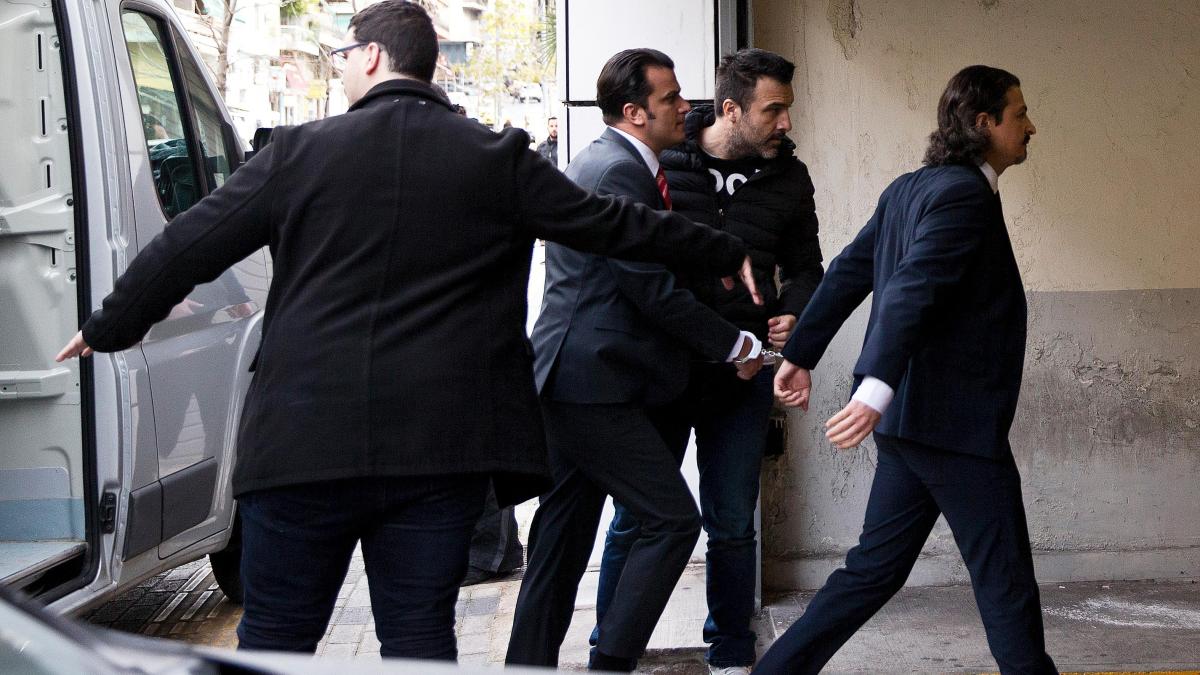
Two Turkish servicemen being taken in handcuffs to the Athens appeals court this morning. The court refused Turkey’s request to extradite them. 
PETROS GIANNAKOURIS/AP
Two Turkish servicemen being taken in handcuffs to the Athens appeals court this morning. The court refused Turkey’s request to extradite them. PETROS GIANNAKOURIS/AP


Date posted: March 16, 2018

Anthee Carassava, Athens

The number of Turks claiming asylum in Greece has increased 40-fold in three years, according to figures released by Athens, as more people face prosecution for their alleged role in a failed coup against President Erdogan.

The precise number of people moving across the border is not known, but figures released by the Greek government this morning showed that asylum claims had risen from 43 in 2015, to 1,827 last year.

Applications have soared since the ill-fated coup attempt against Mr Erdogan in 2016. The Turkish government responded with sweeping purges and prosecutions of supporters of the popular Hizmet movement, led the US-based cleric Fethullah Gulen, whom Turkish officials have blamed for orchestrating the rebellion.

An estimated 151,967 state officials and civil servants have been sacked from their jobs, according to Turkey Purge, a group that charts actions against opponents of Mr Erdogan. About 4,500 judges and prosecutors have been hardest hit by the campaign, as well as an estimated 5,822 academics — the bulk of the defectors pouring into Greece.

The most high-profile case concerns eight Turkish servicemen. This morning an Athens appeals court refused a request by Turkey to extradite the men. Mr Erdogan’s government wants to try them for their alleged role in mobilising a mutinous faction in Turkey’s armed forces during the failed coup, before hijacking a military helicopter and fleeing to northern Greece.

All eight men have denied the allegations and the appeals court upheld an earlier Supreme Court ruling blocking their extradition for fear that they would not receive a fair trial in Turkey. EU and Greek law forbids extradition to a country where an alleged offender would be at risk of torture, as the eight fugitives have argued they would be.

Turkey has attempted to influence the outcome of the case by leaking footage of the servicemen, many of them armed with handguns, being pursued by elite guards after the coup attempt.

This month two Greek soldiers were arrested after straying into Turkish territory while pursuing alleged illegal immigrants. The soldiers have since been held in Turkish custody in the western province of Edirne, facing charges of illegal entry and spying.


Source: The Times , March 16, 2018


Related News

Turkish police brutally torture suspect over Gulen links

One of the most torture incidents reported province is Afyon in Turkey. Afyon Police brutally tortures suspects over Gulen links. One of the victims who is a teacher in this video tells about tortures he went through.

Wife of arrested teacher: I was offered to lie about others in exchange for my husband’s release

The wife of one of the teachers detained in a government-led operation against people deemed to be affiliated with a civil society organization demonized by the ruling party was asked to provide false testimony against those in custody in exchange for having her husband released.

Erdoğan steps up hateful speech against Gülen

President Recep Tayyip Erdoğan stepped up his attacks on Monday against members of a leading civil society group who are critical of his divisive discourse and discriminatory policies, calling the group modern “Lawrences of Arabia.”

Islamist daily published profiling story in 2010

The Islamist Akit daily published a story on illegal profiling conducted by the National Intelligence Organization (MİT) that targeted religious groups back in 2010, long before the Taraf daily, which is currently under fire from the government for publishing similar documents, the authenticity of which have been confirmed by the government.

Gov’t pins hope on division in Turkey as Erdoğan resorts to hateful speech

In an attempt to divert pressure from public opinion from him, Erdoğan is waging a war against the Hizmet (Service) movement, which has openly called on the government to clamp down on the wrongdoers and clean politics of dirt.

Turkey’s permanent state of crisis

However, Erdogan has a problem: Whereas Ataturk came to power as a military general, Erdogan has a democratic mandate to govern. Ataturk’s Turkey was rural and only 10 percent of the country was literate at the time, with most educated people supporting his agenda. Erdogan’s Turkey is 80 percent urban and nearly 100 percent literate, and many well-educated Turks oppose his agenda.

Latest News

Turkish inmate jailed over alleged Gülen links dies of heart attack in prison

Message of Condemnation and Condolences for Mass Shooting at Bondi Beach, Sydney

Media executive Hidayet Karaca marks 11th year in prison over alleged links to Gülen movement

ECtHR faults Turkey for convictions of 2,420 applicants over Gülen links in follow-up to 2023 judgment

New Book Exposes Erdoğan’s “Civil Death Project” Targeting the Hizmet Movement

European Human Rights Treaty Faces Legal And Political Tests

ECtHR rejects Turkey’s appeal, clearing path for retrials in Gülen-linked cases

Erdoğan’s Civil Death Project’ : The ‘politicide’ spanning more than a decade

Fethullah Gülen’s Vision and the Purpose of Hizmet

In Case You Missed It

Fethullah Gulen: Turkey’s Eroding Democracy (op-ed in NY Times)

CSOs slam ongoing black propaganda against Hizmet movement

Gov’t lifts confidentiality of MGK docs for publishing in partisan press

Portrait of Fethullah Gülen: A Modern Turkish-Islamic Reformist

“Islam without Extremes” in Salt Lake City

Kimse Yok Mu awarded in Davos

Democracy is vanishing in Turkey, specialist says

Copyright 2026 Hizmet News