
Hate Speech is Undermining Turkey’s Fragile Democracy
Date posted: October 10, 2014
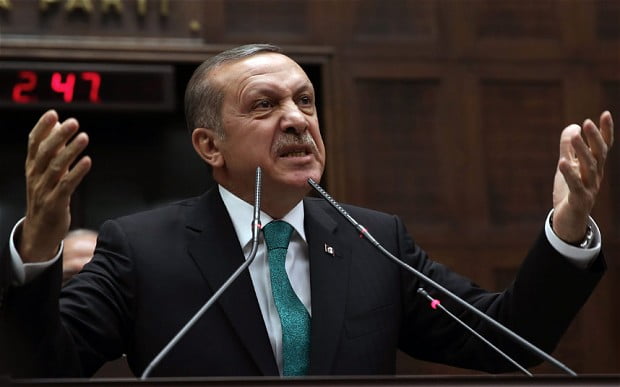
Many TV viewers could not believe their ears upon hearing the terms “blood sucking vampires, leeches, traitors, spies, worse than Shiites, and assassins” uttered by then Turkish prime minister Erdogan in his political rallies.
Immediately after a graft probe involving members of his cabinet became public, then prime minister Erdogan targeted the Gülen movement (a.k.a. Hizmet), one of the largest faith-based communities in Turkey, with offensive statements. Erdogan labeled the probes “a political coup” and accused prosecutors, police chiefs and judges involved in the probes as being sympathizers of Fethullah Gulen. In the subsequent months, the prime minister used every opportunity to defame and slander Gulen and his sympathizers with phrases like “Pennsylvania gang”, referring to Gulen’s state of residence. In a report published recently, D.C.-based Think Tank ReThink underlined that Erdogan’s language clearly represents hate speech as defined by European Court of Human Rights.
A video with English translations illustrates the vulgar language and hate speech used by Erdogan, who has relentlessly worked to make Gulen’s sympathizers a scape goat and ostracize part of the Turkish society as part of a campaign to cover up the corruption investigations involving his cabinet members and his government’s violation of human rights and eradication of freedoms.
Erdogan has employed a multidimensional effort to intimidate, silence and otherwise persecute every institution or individual remotely associated with Gulen. The latest victim of this campaign is Asya Bank, which is targeted by politicized regulatory bodies in Turkey under pressure by Erdogan.
Hizmet is a recognized global civic society movement in as many as 160 countries. The movement benefits the less fortunate with educational and peace-building efforts. They address poverty, illiteracy and ignorance by investing in schools, hospitals, dialogue centers, relief work and numerous other NGOs. Participants and volunteers number in the millions across six continents.
Active since the early 1970’s, the movement has more than four decades of experience dealing with difficult circumstances. Mr. Gulen’s numerous media interviews attest to his firm belief in the rule of law, human rights, due process and the service to others, as well as his belief and love in God and country. A 60 Minutes report on CBS News reveals the passion with which Hizmet participants work and uphold the values of democracy, respect and education.
It’s not hard to recall that Turkey was once a model democracy in the Middle East and was the example many commentators hailed during the Arab Spring. Sadly, that is no longer the case.
During my private conversations in Washington DC, many scholars and experts have come to realize the U-turn Erdogan made during his third term in office. More recently, Erdogan’s refusal to provide full support for the campaign against ISIS terrorist organization puzzled Turkey’s western allies. Despite the sympathy they felt for the 49 hostages held by ISIS, Turkey’s friends have hard time understanding Turkish leaders’ failure to commit to stopping ISIS recruitment in Turkey and their funding mechanisms that rely on Turkish border transactions.
Like many, I too was naive. Like others, we saw the AKP’s efforts to improve and increase interest in EU ascension, rule of law, constitutional reform, democratic values, respect and rights to all sectors of society, basic human rights as sincere.
Erdogan’s U-Turn is understood in many D.C. circles as “power poisoning”. Unfortunately, Turkish society is no stranger to authoritarian practices by their government or military-dominated post-coup administrations.
On the back of a seemingly economic high, at least until recently, Erdogan continues to win elections and grows his illiberal democracy. To this end, he may appear successful. But such derision and polarization in a country — and history has shown this — is not sustainable. They’ve gone from being ‘justice and development’ party to ‘justice or development’.
President Obama smartly reprimanded Erdogan for polarizing the community and increasing anti-Semitism . While the world’s major leaders came together at the NATO summit to discuss ISIS and terrorism, Erdogan was happy to bring to the fore to discuss Gulen and Hizmet.
Erdogan’s demise will not come at the hand of foreign plots or alleged domestic coups – but by his very own hands. His polarizing rhetoric shows no signs of care for the country’s social cohesion.
Source: Huffington Post , October 9, 2014
Tags: Democracy | Hizmet and politics | Peacebuilding | Turkey |


