
US says Turkey favors Sunni Islam over other creeds
Date posted: July 31, 2014
A US State Department report has claimed that the Turkish government is prejudiced in favor of its Sunni Islamic citizens and neglects the needs of members of the country’s other minority religions, in addition to frequently employing anti-Semitic rhetoric.
The US State Department Bureau of Democracy, Human Rights and Labor released its 2013 “International Religious Freedom Report” on Monday.
In its Turkey section, the report said that the US government estimated the Turkish population to be 80.7 million as of July 2013. The report also mentioned that according to the Turkish government, religious affiliation within the country is 99 percent Muslim, with the majority practicing Hanafi Sunni Islam, but “representatives of other religious groups state the actual percentage of Muslims is slightly lower.”
The report says that academics estimate there are between 15-20 million Alevis in Turkey, and that “other religious groups, mostly concentrated in İstanbul and other large cities, together constitute less than 1 percent of the population.”
Mentioning that there are no exact figures available, the report stated that there are: “500,000 Shiite Jaferi Muslims; 90,000 Armenian Orthodox Christians (of which an estimated 60,000 are citizens and an estimated 30,000 are undocumented immigrants from Armenia); 25,000 Roman Catholics (mostly recent immigrants from Africa and the Philippines); 21,000 Jews; 20,000 Syrian Orthodox Christians (also known as Syriacs or Suriyanis); 15,000 Russian Orthodox Christians (mostly recent immigrants from Russia who hold residence permits); 10,000 Bahais; 5,000 Yezidis; 5,000 Jehovah’s Witnesses; 7,000 members of other Protestant denominations; 3,000 Iraqi Chaldean Christians; and up to 2,500 Greek Orthodox Christians” in Turkey.
According to the report, some groups estimate that approximately 2 percent of the population is atheist.
The State Department report added: “Non-Sunni Muslims, Christians, Bahais and members of other minority religious groups faced threats and societal suspicion, and Jewish leaders reported some elements of society continued to express anti-Semitic sentiments. Because ethnicity and religion were often inextricably linked, it was difficult to categorize many incidents specifically as ethnic or religious intolerance.”
The report expressed the concern of many Jewish leaders, some of whom “ attribute anti-Semitic graffiti and threats to events in the Middle East and anti-Semitic rhetoric by Prime Minister [Recep Tayyip] Erdoğan and other government officials.”
The Gezi Park protests which started in İstanbul last summer were described in the report as “anti-government protests.” The report also said that “Erdoğan and several senior government officials repeatedly and publicly blamed ‘shadowy’ international groups for the unrest, including … an ‘international Jewish conspiracy’ [and an] ‘interest-rate lobby’.” The report pointed out that in July last year, “Deputy Prime Minister Beşir Atalay blamed the ‘Jewish diaspora’ for the Gezi Park unrest, [and that] these statements by senior political leaders were accompanied by anti-Semitic reports and commentaries in media outlets friendly to the government.”
According to the report, “[the Turkish Constitution] and other laws and policies generally protect religious freedom, although there were some constitutional provisions, laws and policies that restrict religious freedom.” While the report praised the government for lifting the ban on headscarves in public except for judges, prosecutors, police and the military, it criticized the failure to approve the opening of the Greek Orthodox Halki seminary, which has been closed more than 40 years.
The report also cited the government’s announcement that it will return “disputed land to the Mor Gabriel Syriac Orthodox Monastery” as a positive development.
Problem of Alevi places of worship
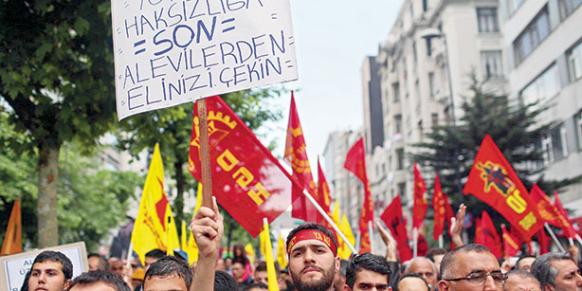
The government continues to refuse to recognize Alevi places of worship (cemevis) as legal places of worship, according to the report. The Turkish government considers Alevism a heterodox Muslim sect and does not financially support Alevi religious practices.
The report also described Islamic scholar Fethullah Gülen as a “well-known Sunni theologian,” while mentioning his support for three Alevi and three Sunni businessmen who conducted a ground-breaking ceremony in Ankara in September for a religious and cultural complex which included — for the first time — a mosque and a cemevi side by side. However, 11 Alevi foundations last year released a statement condemning the construction, calling it a “project of assimilation.”
“Although religious speech and conversions are legal, some Muslims, Christians, and Bahais faced government restrictions, surveillance, and harassment for alleged proselytizing,” said the report. The report mentioned that it was “generally not possible” for foreigners to obtain a “religious worker visa” in Turkey, although the government claims it is possible. Several foreigners, including US citizens, who resided in Turkey under other visa categories “were deported after requesting religious worker residence permits,” the report claimed. Persons wishing to convert from Islam, according to the report, experienced harassment and violence from relatives and neighbors.
“The government continued not to recognize the status of the Ecumenical Patriarchate as the leader of the world’s 300 million Orthodox Christians, consistent with its stance there was no legal obligation to do so,” the report said. Turkey says the Patriarch is not “’ecumenical,’ but only the religious leader of the country’s Greek Orthodox minority population.”
According to the report, Bahais, Alevis and Yezidis are unable to have their religious identity stated on their national identity cards because their groups are not listed as options.
Source: Today's Zaman , July 30, 2014
Tags: Dialogue | Fethullah Gulen | Turkey |


