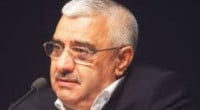
Religious leader: I was told to blame Gülen movement for police banning my group meeting


Date posted: June 20, 2017

Alparslan Kuytul, president of the Furkan Foundation and leader of a religious group critical of the Turkish government, said he was advised to put the blame on the faith-based Gülen movement for a police intervention in a meeting of his followers in April and that the government would ultimately clear the way for his group to operate freely.

Speaking in a video recently published in the foundation’s website, Kuytul said a person, apparently close to the government, approached one of his advisers during a press conference in İstanbul in April after a violent police intervention in a gathering of his followers in Adana and said, “Tell your leader his way will be cleared if he blames FETÖ [a derogatory term used by government circles to refer to the Gülen movement].”

“I told my adviser to tell him that I would be a dishonest person to tell such a lie,” Kuytul said in the video.

On April 22, police in Turkey’s Adana province attacked members of the Furkan Foundation after Kuytul announced opposition to a presidential system of governance proposed by the ruling party Justice and Development Party (AKP).

When a group of around 200 people, including women and children, gathered at Atatürk Park in downtown Adana and representatives of the foundation wanted to read out a press release to mark the Holy Birth Week of the Prophet Muhammad, police attacked them with water cannons and tear gas after warning them that their gathering was not permitted.

When members of the group insisted on continuing with the event, 50 people were detained and four others were taken to a hospital after suffering injuries during the police intervention.

Following a failed coup last summer for which Turkish authorities blame the Gülen movement, a smear campaign was launched by government circles as part of efforts to demonize sympathizers of the movement, despite the fact that Fethullah Gülen, whose views inspired the movement, continuously has denied any involvement in the coup.

Source: Turkish Minute , June 20, 2017


Related News

Erdogan’s parallel state in Kosovo functions despite PM Haradinaj

More importantly, is there any role played by President Hashim Thaçi who is known to be very close to the Turkish government? After all, it seems that Turkey’s Erdogan has a parallel state in Kosovo that executes decisions without the the knowledge of the incumbent prime minister and minister of foreign affairs.

Erdogan’s diplomats have become ‘Gulenist-busters’

A diplomat told me that there was no way he would do what Tayyip Erdogan was asking him to do. It was against everything he held dear: chasing one’s own citizens without any credible evidence. Soon, many diplomats who refused to turn into Gulenist-hunters were not promoted, demoted or, worse, expelled from the ministry.

Turkey’s Gulen Demand – The U.S. shouldn’t extradite the exiled Turk without better evidence

Turkey is demanding that the U.S. extradite Fethullah Gulen whom Ankara accuses of orchestrating this month’s failed military coup. “The evidence is crystal clear,” PM Yildirim told the Journal Tuesday, adding that Washington’s request for evidence of Mr. Gulen’s guilt is superfluous “when 265 people have been killed.” If that’s Mr. Yildirim’s standard of proof, Washington should deny the request.

Gülen warns against adventurism, using force against Kurds

Turkish Islamic scholar Fethullah Gülen has warned against adventurism as well as using force to respond to demonstrations that have turned violent since reports that the terrorist Islamic State in Iraq and the Levant (ISIL) has captured the strategic city of Kobani (or Ayn-al Arab) over the weekend.

Politics and communities

The state can no longer control the estate in its entirety. As a matter of fact, society and politics cannot be perceived as an “estate.” Thus, civil forces and communities want to be influential over decision-making mechanisms related to political processes and public polices, not over the state.

European court rules Asya-like seizure of bank unfair

In a decision that could potentially set a precedent for similar cases in Turkey, the Strasbourg-based European Court of Human Rights (ECtHR) on Tuesday ruled that the seizure of the country’s Demirbank in 2001 was unfair.

Latest News

Turkish inmate jailed over alleged Gülen links dies of heart attack in prison

Message of Condemnation and Condolences for Mass Shooting at Bondi Beach, Sydney

Media executive Hidayet Karaca marks 11th year in prison over alleged links to Gülen movement

ECtHR faults Turkey for convictions of 2,420 applicants over Gülen links in follow-up to 2023 judgment

New Book Exposes Erdoğan’s “Civil Death Project” Targeting the Hizmet Movement

European Human Rights Treaty Faces Legal And Political Tests

ECtHR rejects Turkey’s appeal, clearing path for retrials in Gülen-linked cases

Erdoğan’s Civil Death Project’ : The ‘politicide’ spanning more than a decade

Fethullah Gülen’s Vision and the Purpose of Hizmet

In Case You Missed It

Turkish Civil society groups: Lack of hate crimes legislation hurts citizens

Coup and Countercoup in Turkey

From ‘parallel state’ to ‘terrorist organization’: Dissecting Erdoğan’s labeling of Gülen

Congratulations to Fethullah Gulen and Izzettin Dogan

Islamic Scholar Fethullah Gulen promotes peace, understanding

Dr. Reuven Firestone Interviewed by Muslim Turkish Movement “Hizmet”

Islamist daily published profiling story in 2010

Copyright 2026 Hizmet News