
UN Interfaith Iftar Dinner
Date posted: June 20, 2016
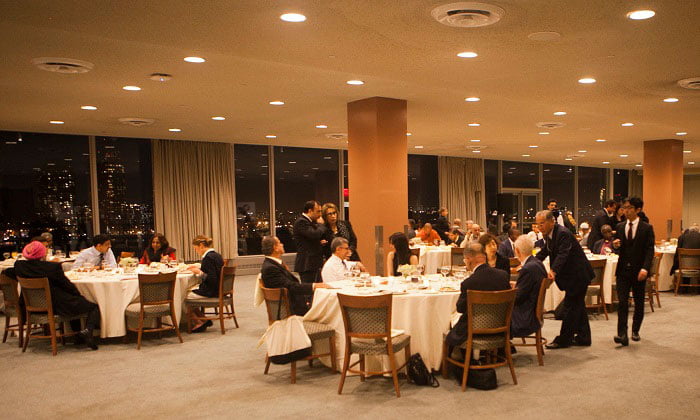
The first Iftar Dinner of 2016 was given at the United Nations by Peace Islands Institute and the Journalists & Writers Foundation. The Iftar dinner gathered members of different faith communities to give a message of peace, harmony, and solidarity to the whole world. Despite conflicts and violence extremism that are happening around the world, faith communities stand united together as One celebrating the traditions of fating in different religions.

On the same day, Peace Islands Institute and the Journalists & Writers Foundation in partnership with Nagasaki Interfaith Council (Japan) and Buddhist Council of New York, organized a United Nations Interfaith Conference titled: “The Role of Interfaith Education in Conflict Prevention and Sustainable Peace” at the UN ECOSOC Chamber at 3-6 pm. Following the conference, the UN Interfaith Iftar dinner was held at the United Nations’ Delegates Dining Room. The Iftar dinner brought together member states and civil society organizations from Japan, Mozambique, Pakistan, India, Turkey, Ethiopia, and the USA – leaders who are the movers and shakers of social change in their communities. The dinner aimed to share the traditions of fasting in the religions and cultures across the globe, as well as provide a message of peace – we stand stronger when united.

The speakers comprised of leading academics, experts and religious figures, all of which gathered to collaborate and discuss how interfaith education, tolerance, and respect for diversity on a global scale, can propagate sustainable global peace. As part of the UN Sustainable Development Goals, it is integral that both religious leaders and civil society organizations support peace and inclusive societies.

.
Mehmet Kilic, the Director of the Center for Global Affairs at the Peace Islands Institute opened the dinner, describing the importance of global issues, such as climate change and violent extremism that are now trickling down to affect each of us in our local communities.
.
..

.
He invited the first speaker Huseyin Hurmali, the Vice-President of Journalists and Writers Foundation to the platform. Mr. Hurmali discussed how the foundation works to encourage peace-building and sustainable development. The peace can only be stimulated when people from all walks of life, religions and beliefs can unite together, instead of divide separately.
.
 .
.
Hakan Yesilova, the editor-in- chief of The Fountain Magazine spoke about the beauty and richness of our diverse global cultures and identities, of which we can only appreciate when “we come together, meet one another, and thus get to know one another”. He highlighted the meaningfulness of the Iftar dinner, which brings together a diverse range of people to break the same bread and share the same table, as well as engage in introspective dialogue within a safe and secure space.
..
.

The former Archbishop of Mozambique, Dinis Salomão Sengulane, spoke on the peacefulness and inclusivity of fasting, which has made him feel invited during the time of Ramadan. He went on to support this cooperation, as “In all of our spiritual journey’s, we must ensure that we are investing in peace”.
 Fariha Pervez, a celebrated singer from Pakistan performed a Sufi musical piece that illustrated the importance of compassion and dangers self-pride. Ramadan is a time of self-control, self-reflection and caring for one another whatever religion or belief one may have. Thus during this blessed period, the role of interfaith education is all the more crucial in expediting world peace.
The recent surge of violent extremism and religious radicalisation has no doubt influenced contemporary global issues. However, with a better understanding of interfaith dialogue, a concept that positively promotes acceptance in the diversity of our religions and belief systems, we can continue to work towards global sustainable peace.
.

Amir Vahab and his Ensemble performed Sufi music from different regions of the world during the dinner. Music is the universal language that contributes to peace, harmony, and solidarity among people from diverse cultural, religious, ethnic, and national backgrounds.
Source: Peace Islands Institute , June 15, 2016
Tags: Dialogue | North America | USA |


