İstanbul hosts dialogue leaders to discuss tolerance in education
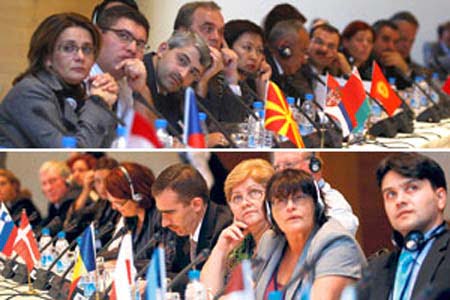
Represantatives from around 30 countries are in İstanbul for a conference titled
Represantatives from around 30 countries are in İstanbul for a conference titled "Tolerance and Dialogue in Education," held to bring European and Asian experts together for discussions on education


Date posted: September 30, 2009

MAHIR ZEYNALOV

“What we are doing here is for the better future of our people, to tackle global threats and institute global peace,” said Rostislav Rybakov, head of the Institute of Oriental Studies, during a conference held in İstanbul on Monday to discuss tolerance and dialogue in education.

The Dialogue Eurasia Platform (DEP) together with the İstanbul Municipal Education Administration and the İstanbul 2010 European Capital of Culture Agency opened a four-day conference in İstanbul on Monday under the title of “Tolerance and Dialogue in Education.”

The primary purpose of the meeting is to bring Europeans and Asians together and propose grounds for discussion. Its organizers also aimed to launch the unofficial opening of the İstanbul 2010 European Capital of Culture celebrations in terms of education. Invitations sent to 42 countries and representatives from 25 countries joined the conference, which plans to bring related educational and dialogue organizations together to deal with tolerance and dialogue in education.

The opening ceremony of the conference started with a presentation on the importance of intercultural and interfaith dialogue and Dialogue Eurasia Platform’s contribution to this.

The presentation stressed the importance of dialogue and tolerance, and people were called on to respect diversity and differences while stressing the significant role of peace and love. “The Dialogue Eurasia Platform is blind to differences, race and diversity and does not recognize any conflicts,” it said.

Head of the İstanbul Education Department Muammer Yıldız, head of Pedagogical Club of European Capitals Boris Jebrovski, co-chair of the Dialogue Eurasia Platform and honorary chair of Russian Academy of Sciences, Institute of Oriental Studies, Rostislav Rybakov, prominent scholar and dialogue activist Nevzat Yalçıntaş, head of the Journalists’ and Writers’ Union Mustafa Yeşil, Deputy Governor for Educational Affairs Harun Kaya and head of the Turkish Parliament Education Commission Mehmet Sağlam were among the participants of the conference.

At the end of the first day, it was announced that the applicable recommendations will be prescribed at the end of the conference. These recommendations will be sent to the participant countries’ education ministries, UNESCO and the UN.

Throughout the conference discourse on peace, love, respect of diversity dominated the speeches by all speakers. The speakers were representing both educational ministries of different countries and educational organizations from various countries. “Our differences are our beauty,” said Yıldız, head of İstanbul Education Department. “We educators are responsible for building an environment of tolerance and dialogue. Our job is to contribute to universal peace.”

The head of the Institute of Oriental Studies, Rybakov, listed seven guiding principles for global peace. “İstanbul is the seventh golden principle. Its mosaic of different cultures and religions is a wonderful sign of coexistence and respect for diversity,” he said. Drawing similar lines between Indian peace activist Mahatma Gandhi and Turkish scholar Fethullah Gülen, Rybakov said Mahatma Gandhi had certain political motives yet Gülen is a “gardener.” “Fethullah Gülen is an initiator of a new culture, a new man who is ready to love,” Rybakov concluded.

The conference is expected to finish on Sept. 30 with policy recommendations for different organizations and ministries of education with respect to dialogue and tolerance in education.

Source: Today’s Zaman, 29 September, 2009


Related News

Peruvian congress members speak about sociopolitical issues at PII in New York

Considering the recent developments in Turkey, many could find significant similarities between Turkey’s challenges with democratic transition and Latin American politics.

A Different Kind of Coup? Why You Should Care About A “Reclusive” Turkish Imam in Pennsylvania

We should consider not only what people say about Fethullah Gülen, but what he says himself. Decades of speeches and publications make this possible and reveal certain attributes. For example, Gülen advocates a form of Sufi humanism. He seeks collaborative relationships across religious, cultural, and national borders. He is concerned about the poor and marginalized around the world.

In Erdogan regime western-oriented intellectuals, bureaucrats, liberals, Kurds, civil society activists in mortal danger

Those in prison—educated, Western-oriented intellectuals and bureaucrats, liberals, Kurds, civil society activists, and supporters of exiled cleric Fethullah Gülen—are in mortal danger. When blood flows from the prisons, it will be no accident nor should anyone believe Erdogan’s security forces were simply reacting to a crisis.

Who stalls the reforms [in Turkey]?

ABDÜLHAMİT BİLİCİ “A group of people, including businessmen, students and teachers who came all the way from Thailand, traveling 9,000 kilometers to cast their votes in the referendum (on September 12, 2010), are now back to Thailand. Neşet Kahraman, who spent $2,000 on travel in order to cast his vote, said: ‘The referendum was pretty […]

EC official: Turkey should address issues within limits of rule of law

Turkey should deal with its problems within the confines of the rule of law and the legal instruments of democratic societies, Alexandra Cas Granje, European Commission (EC) director of enlargement, has said in reference to a recent corruption scandal and draft bill on the Supreme Board of Judges and Prosecutors (HSYK).

Strategic defamation of Fethullah Gülen: English vs. Turkish

Dr. Koç’s review and statistical analyses show very clearly that the defamation of Gülen and the Hizmet movement is being strategically operated. Gülen is simultaneously portrayed as an Islamic danger who is secretly trying to resurrect the Ottoman Empire and caliphate (in English) and as an American and Zionist puppet who is destroying Turkey and Islam with his “moderate Islam” (in Turkish).

Latest News

Turkish inmate jailed over alleged Gülen links dies of heart attack in prison

Message of Condemnation and Condolences for Mass Shooting at Bondi Beach, Sydney

Media executive Hidayet Karaca marks 11th year in prison over alleged links to Gülen movement

ECtHR faults Turkey for convictions of 2,420 applicants over Gülen links in follow-up to 2023 judgment

New Book Exposes Erdoğan’s “Civil Death Project” Targeting the Hizmet Movement

European Human Rights Treaty Faces Legal And Political Tests

ECtHR rejects Turkey’s appeal, clearing path for retrials in Gülen-linked cases

Erdoğan’s Civil Death Project’ : The ‘politicide’ spanning more than a decade

Fethullah Gülen’s Vision and the Purpose of Hizmet

In Case You Missed It

Threats and fear used to intimidate business world

Erdogan’s bid to close Gulen schools in Africa opposed

4 people trying to escape persecution in Turkey missing after boat capsizes in Evros River

Pro-gov’t daily: Turkey, Russia could conduct joint operation to abduct Gülen

33rd Abant Platform: whither Turkey?

Turkish school leaves tight quarters for spacious former Wayne corporate building

Turkish citizens in Arkansas face uncertain futures

Copyright 2026 Hizmet News