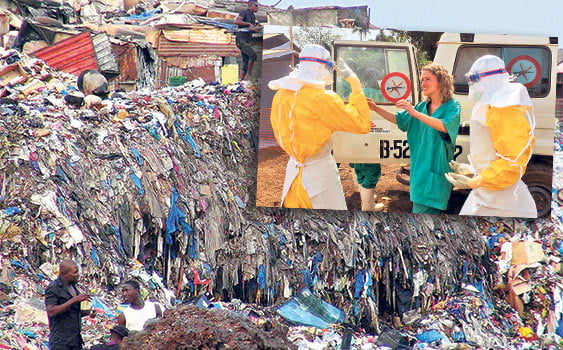
Kimse Yok Mu providing assistance to Ebola victims in Guinea

Date posted: April 30, 2014

GUINEA

Turkish aid organization Kimse Yok Mu has been supplying medical aid to Guinea since March, when the lethal Ebola virus struck the West African country, claiming 122 lives to date.

With the help of Guinean Minister of Family and Social Affairs Camara Sanaba Kaba and Guinean Minister of Communication Alousseni Makanera Kake, Kimse Yok Mu delivered aid from Turkey to areas most affected by the epidemic. The aid organization provided Guineans with 9,000 packages of detergent, 10,000 bottles of chlorine, one ton of soap, 200 bottles of antiseptic liquid, 1,000 masks and 50 boxes of gloves, valued at TL 50,000.

Veysel Kayabaşı, Kimse Yok Mu’s coordinator of health aid, said all border crossings to Guinea have been closed due to the Ebola epidemic and that more precautions are urgently needed to stop the virus from spreading. Kayabaşı added that they have been doing their best to stem the epidemic and explained that there is no known cure for Ebola. Experts have been warning locals not to eat wild animals or bats, which carry the disease; they are also being educated on hygiene. “We are supporting them by raising awareness,” Kayabaşı noted.

The World Health Organization (WHO) has announced that the Ebola virus, seen in Guinea for the first time in March, is the most dangerous virus that exists in the world. The WHO noted that 25 percent of people afflicted with Ebola end up dying; unless precautions are taken early, they warn, the death rate might rise to 90 percent.

It is estimated that nine out of 10 Ebola patients receive the virus from a wild animal; as such, consuming wild animal meat has been prohibited in the region.

Ebola was first seen in 1976 in the Democratic Republic of Congo. Since then, almost 300,000 people have died in 15 separate epidemics. Ebola is transmitted to humans via blood and other body fluids.

Source: Todays Zaman , April 29, 2014


Related News

Erdogan’s critics in Germany living in fear of his long arm

When Ercan Karakoyun goes to a restaurant in Kreuzberg or Neukölln, Berlin’s boroughs with a large migrant population, he never sits with his back to the door. When he leaves, he looks left and right before exiting, to make sure no one is waiting for him. He also stopped visiting Turkish mosques, fearing an attack.

Conceptual contradictions when it comes to rhetoric about ‘parallel state’

.In the wake of the Dec. 17 corruption operations that took place in Turkey, the government removed and changed such an extraordinarily high number of people from their positions in the police force, the justice system and the national education structure that these changes certainly would not have been possible in a state of law. An attempt was made to see these changes happen within the framework of heavy propaganda about the concept of the existence of a “parallel state.”

Documents reveal how military carried out campaign against the Gulen [Hizmet] movement

CEMAL A. KALYONCU, İSTANBUL Documents retrieved from computers of the Information and Support Unit of the General Staff clearly reveal how a pro-coup junta nested within the Turkish military, the Turkish Armed Forces (TSK), has engaged in propaganda to discredit the government and faith-based groups in the eyes of the people. Special unit to fight […]

Threat to destroy the Hizmet Movement a hate crime

Erdoğan’s harsh attacks on the Hizmet movement, consisting of followers and sympathizers of Fethullah Gülen, reached a summit when he stated on Tuesday, “from A to Z everyone in this organization needs to pay the price. Either they will accept the presence of this state or they will disappear.”

EP kills parallel state lies

Nobody believes that the mass culling and reassignment of up to 10,000 public officials (most from the police department and the judiciary and many of whom are mid-level and senior personnel) so far by embattled Prime Minister Recep Tayyip Erdoğan has anything to do with what the government purports is a fight against a “parallel structure,” a veiled reference to members of the Hizmet movement inspired by Islamic scholar Fethullah Gülen.

Erdogan’s False Promises To Africa

The main issue Erdogan raises with his African counterparts is not improving economic and political relations, but the closure of the Gulen movement schools or their transfer to the Turkish Maarif Foundation, which was established solely for this purpose. Mr. Erdogan seems to be using official development assistances and “other financial tools” as carrots to convince African leaders.

Latest News

Turkish inmate jailed over alleged Gülen links dies of heart attack in prison

Message of Condemnation and Condolences for Mass Shooting at Bondi Beach, Sydney

Media executive Hidayet Karaca marks 11th year in prison over alleged links to Gülen movement

ECtHR faults Turkey for convictions of 2,420 applicants over Gülen links in follow-up to 2023 judgment

New Book Exposes Erdoğan’s “Civil Death Project” Targeting the Hizmet Movement

European Human Rights Treaty Faces Legal And Political Tests

ECtHR rejects Turkey’s appeal, clearing path for retrials in Gülen-linked cases

Erdoğan’s Civil Death Project’ : The ‘politicide’ spanning more than a decade

Fethullah Gülen’s Vision and the Purpose of Hizmet

In Case You Missed It

Kimse Yok Mu provides eid meat for needy Thais

Education remains an alarming concern for scores of Syrian refugees

Turkey Now Back in Africa with Turkish Schools

Turkish schools building peace in Africa

Gülen Schools and Rule-of-Law in Turkey

The AKP as a party: Is it Islamic, statist or just opportunist?

Gulen Institute awards student essay winners in Washington

Copyright 2026 Hizmet News