
Erdoğan’s Civil Death Project’ : The ‘politicide’ spanning more than a decade
Date posted: November 4, 2025
A new book released on October 15 says Ankara pursued a systematic campaign to erase a civic movement from public life. “The book is about the systematic and relentless persecution … to bring about their civil death,” Turkish lawyer and human‑rights advocate Coşkun Yorulmaz, co-author of the book, told Turkish Minute in an interview.
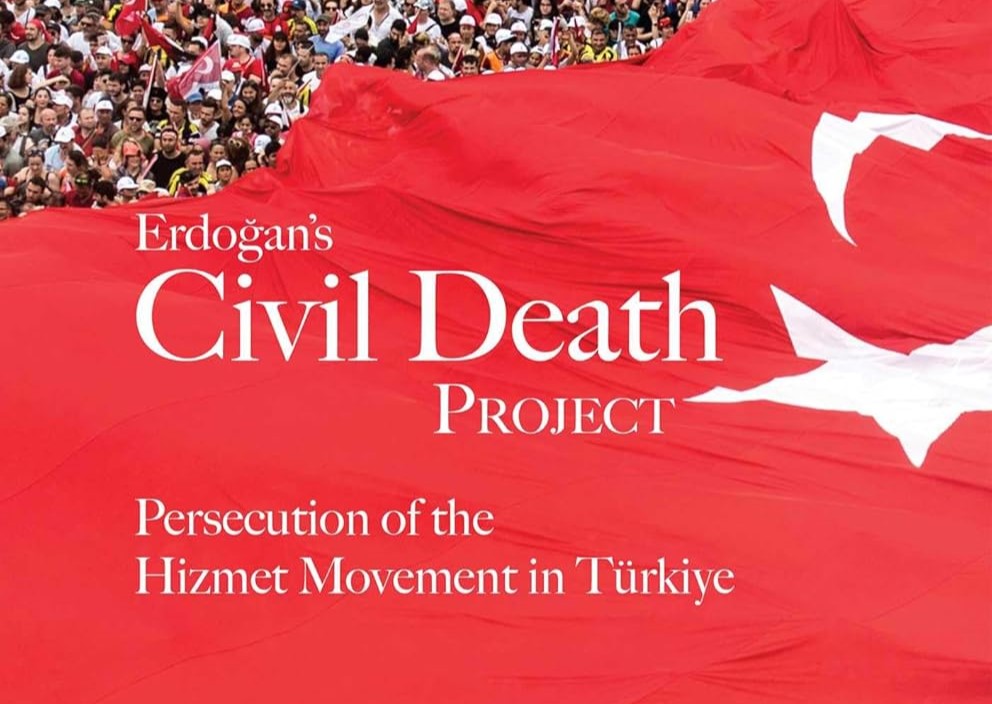
“Erdoğan’s Civil Death Project: Persecution of the Hizmet Movement in Türkiye,” co‑authored by James C. Harrington, a human rights attorney with nearly four decades of experience, and Yorulmaz, frames a decade of purges, prosecutions and smear campaigns as an attempt to annihilate a social movement that once backed Turkey’s reformist turn. The book contends President Recep Tayyip Erdoğan and the ruling Justice and Development Party (AKP) “initiated a lawless process” after 2013 that made the denial of basic rights “state policy,” culminating in “the largest public‑employee expulsion recorded in world history” and a continuing pattern of detentions and trials.
Speaking to Turkish Minute, Yorulmaz distilled the thesis in plain terms: “It is the persecution of a particular group in Turkey … known collectively as the Hizmet movement … to bring about their civil death and for political purposes only.”
He said the campaign predated a failed coup in July 2016 but accelerated under the emergency rule that followed the attempted putsch, when the government governed “by decree” for two years. “All of a sudden, the country was being ruled … by the palace, by decrees,” he said.
Hizmet (Turkish for “service”), also known as the Gülen movement, is a volunteer‑driven, faith‑rooted civic movement inspired by Muslim cleric Fethullah Gülen, who died in the United States in October 2024. The movement emphasizes education, interfaith dialogue and humanitarian relief, operating schools and charity networks in dozens of countries. The book describes the Gülen movement as a global civil‑society initiative that “abjures violence” and seeks social good through education and community work.
“Hizmet is a global and civic initiative … driven by volunteers,” Yorulmaz says, with education as its “main driver,” plus interfaith and intercultural dialogue and humanitarian aid. “It tries to create positive social change through service rather than political means,” he said.
The book traces a three‑act rupture between Erdoğan and Hizmet: the 2013 Gezi Park protests and the harsh state response; the December 2013 corruption probes that implicated Erdoğan’s inner circle; and the July 2016 coup attempt, months before which the state moved to label Hizmet a terrorist organization and started to purge perceived sympathizers en masse after the abortive putsch. It argues that Erdoğan used the coup as a pretext to consolidate power, ruled by decree under a two‑year state of emergency and reshaped courts and policing to criminalize dissent.
The Gezi Park protests began in May 2013 as a small demonstration against government plans to redevelop one of central İstanbul’s last green spaces. They quickly grew into nationwide anti-government rallies challenging then-prime minister Erdoğan’s increasingly authoritarian rule.
As the protests spread, Yorulmaz says Gülen publicly asked at the time whether the project is “worth a single drop of blood,” a stance Yorulmaz says infuriated Erdoğan and marked his “first drift” with Hizmet. Then, the late‑2013 graft cases, “the point of no return” after which Erdoğan blamed the movement and recast the judiciary’s graft probes as a “judicial coup.”
Finally, the 2016 coup attempt. “For many people it’s a false‑flag operation,” Yorulmaz said of the abortive putsch, noting no independent international commission ever examined it, despite Gülen’s call for one.
The book’s introduction recounts that within hours of the coup attempt the government publicly blamed Hizmet, blocked meaningful investigation and then “unleashed the most intensive and extensive hate‑driven campaign in modern Turkish history.” It asserts that by 2024 the state still had not produced evidence to substantiate its terrorist designation for the movement.
The Turkish government has for years labeled the movement “FETÖ”(for “Fethullahist Terrorist Organization”), alleging it orchestrated the 2016 coup attempt and penetrated the state. Those claims anchor tens of thousands of prosecutions and a continuing dragnet. The book reports that no Western country recognizes Hizmet as a terrorist organization and argues that Ankara’s “FETÖ” label became a tool to normalize mass arrests, firings and social ostracism, what the authors call “politicide, a political version of genocide.”
Yorulmaz, for his part, calls the label a political bludgeon that justified what he describes as “witch‑hunt” tactics: criminal investigations of millions, trials on vague charges and civil penalties that follow people out of prison and into everyday life. “You are purging a group from all of society,” he said.
![[INTERVIEW] ‘Erdoğan’s Civil Death Project’ : The ‘politicide’ spanning more than a decade](https://i.ytimg.com/vi/DeBwFOSu8Ew/hqdefault.jpg)
The numbers and a picture of ‘civil death’
The book compiles official statements and independent reports to show the scale of the campaign. Its data summary includes millions investigated over terrorism and over a hundred of thousand convicted since 2016; mass sackings of public servants, including thousands of judges and prosecutors; the closure or seizure of schools, universities, media outlets, charities, hospitals and associations; asset seizures; and the revocation of passports on a large scale. It catalogs detention‑center abuses, torture reports and abductions in Turkey and abroad.
Since 2016 authorities have opened terrorism-related investigations into roughly 2 million people, filed charges against 693,000, secured some 126,000 convictions and dismissed 125,678 public employees, while closing thousands of entities including schools, universities, associations and media outlets
The “civil death” the book describes extends beyond prison gates. Chapters on employment bans, blacklisting codes and seizures argue that people with alleged Gülen ties became unemployable, denied services and stigmatized, in a form of punishment that continues even after an acquittal by Turkish courts. Yorulmaz says that a teacher, once fired, can’t find work in a private school because a note on their file scares off employers. “We saw [former] F‑16 pilots selling pizzas,” he said.
System re‑engineered
The book argues Erdoğan “weaponized three critical props of the state—the judiciary, the religious establishment, and the media—to serve his agenda …” It details the two‑year state of emergency, governing by decree, the mass reshaping of the courts and the creation of new criminal judgeships, as well as the use of the Diyanet, the state religious authority, and pro‑government media outlets to harden public animus. It frames a playbook of hate speech and administrative law that turned a smear vocabulary into policy, then into prosecutions.
Yorulmaz says the state rewrote the rules to make extraordinary measures ordinary.
“He [Erdoğan] issued … 32 decrees in total,” he said of the state of emergency period. “Most people say it was the palace ruling by decree,” with the effect that parliamentary oversight vanished and criteria for defining terrorism shifted.
Human stories behind the statistics
When asked about what “civil death” looks like at eye level, Yorulmaz points to individual cases. One is Halime Gülsu, a teacher detained in 2018 whom Yorulmaz says begged prison officials for access to medication for a serious autoimmune disease. “She wasn’t given her medicine for two months … she went into a coma and passed away,” he said, calling it “one of the most unnecessary deaths.” The book’s chapter on detention and prisons includes a section titled “Halime Gülsu: A Compassionate Teacher.”

Yorulmaz also described torture allegations, enforced disappearances and “black sites” operating outside ordinary legal oversight, patterns the book says have been repeatedly flagged by international monitors and embedded in a wider architecture of hate speech and collective punishment.
Why the authors call it ‘politicide’
“Politicide,” the authors write, is a concept used by the US‑sponsored Political Instability Task Force to describe state violence against groups defined by political opposition rather than ethnicity or religion. In their telling Hizmet became the target of a discriminatory legal edifice designed to erase the movement from public and private life — through purges, prosecutions, smears and social exclusion. The book argues the hate‑infused campaign “violates international human‑rights norms” and edges into crimes against humanity under frameworks like the Rome Statute, which the authors analyze at length.
Yorulmaz points to public statements by senior officials as “stated intent to eradicate” the movement, to religious sermons targeting Hizmet and to parliamentary rhetoric that “made it very clear that it was the government’s intention just to strip these people of all their civil rights.”
A movement’s origins and what remains
Gülen’s core message was the primacy of service, that is, the “most meaningful way to express one’s faith is through positive action,” Yorulmaz says, such as building schools, delivering relief, partnering across differences. He notes Gülen’s 1998 visit to Pope John Paul II as emblematic of a dialogue‑first approach that won admirers abroad and critics at home. “He championed education as the ultimate tool for social good,” Yorulmaz says.
That background matters because, in the authors’ view, what is being uprooted is a civic ecosystem: prep schools, charities, clinics, student dorms, newspapers and dialogue platforms, many now shuttered or seized. The book calls the 2016 closure of Kimse Yok Mu, a Hizmet‑linked disaster‑relief NGO that worked with the UN refugee agency, emblematic of collective punishment with global humanitarian costs.

The foreword, by Harrington, a longtime US civil‑rights lawyer, says he underestimated the depth of what happened until working on the manuscript. He writes that Erdoğan “weaponized” state pillars and deployed hate speech “so recklessly and malevolently” that it coarsened the culture and undermined civil society, and that the drive to eradicate Hizmet “continues unabated.”
The book argues Erdoğan’s campaign succeeded in taming the judiciary and reshaping political life yet failed to eliminate the Gülen movement or the dissent within Turkey. It calls for international scrutiny and for Turkey’s allies to center rule‑of‑law conditionality in dealings with Ankara.
Source: Turkish Minute , October 31, 2025
Tags: Erdogan's Genocidal Treatment of Hizmet | Hizmet (Gulen) movement | Persecution of Hizmet by Erdogan |


