Free speech groups condemn Turkey’s closure of 29 publishers after failed coup
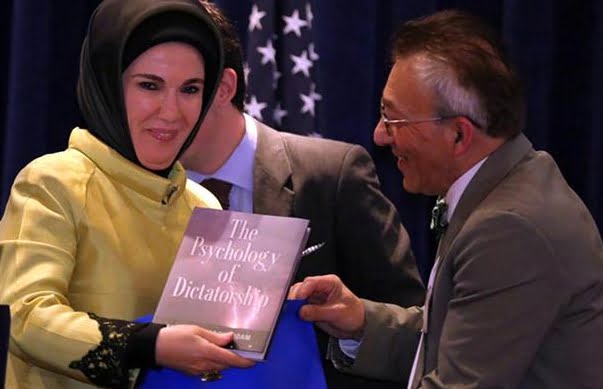
Fathali M. Moghaddam, an Iranian professor at Georgetown University, presents Emine Erdoğan with one of his books, 'The Psychology of Dictatorship'


Date posted: August 3, 2016

Alison Flood

Organisations including PEN International have spoken out about the ‘grave impact on democracy’ caused by major crackdown on book trade.

The closure of 29 publishers by the Turkish government has been condemned by the international publishing community, which described the move as outrageous and warned that it would have a “grave impact on democracy”.

President Recep Tayyip Erdoğan’s government used a state of emergency law to close the 29 publishing houses last week, along with a swath of newspapers, television channels, magazines and news agencies. According to the Turkish Publishers Association, the decree means that all goods, assets, rights, documents and papers belonging to the publishers will be transferred free of charge to the Turkish treasury, with no appeal to be made, and the prospect of further publishers being shut down in the future.

The closures follow the coup attempt last month, which has been blamed on followers of the US-based Muslim cleric Fethullah Gülen, and in which more than 200 people were killed and thousands injured.

The Turkish Publishers Association said that while it opposed the coup attempt, the closure of the publishing houses, which are alleged to be affiliated to Gülen’s network, “carries the risk of human rights violations, the stifling of freedom of thought and expression and also irreparable financial and moral losses”.

In a statement translated by the International Publishers Association, the TPA said that authors and translators whose works were translated by the 29 publishers would suffer, as they would be unable to collect money owed to them. So, too, would the publishers’ employees who “with no criminal involvement, will also be denied their rights, their jobs, and any outstanding wages”.

“We hope that the constitutionally guaranteed principle of ‘innocent until proven guilty in a court of law’ will be respected, that the rule of law and democratic principles will be respected, and that any action that may prevent freedom of thought and expression, freedom to publish and the right to news and information will be avoided,” said the TPA.

The 29 closed publishing houses are: Altın Burç; Burak Basın Yayın; Define; Dolunay Eğitim; Giresun Basın Yayın; Gonca; Gülyurdu; GYV; Işık Akademi; Işık Özel Eğitim; Işık; İklim Basım Yayın Pazarlama; Kaydırak; Kaynak; Kervan Basın; Kuşak; Muştu; Nil; Rehber; Sürat Basım Yayın Reklâmcılık; Sütun; Şahdamar; Ufuk Basın Yayın Haber Ajans Pazarlama; Ufuk Yayınları; Waşanxaneya Nil; Yay Basın Dağıtım Paz Reklâmcılık; Yeni Akademi; Yitik Hazine; and Zambak Basım Yayın Eğitim Turizm.

Their closure was also protested by free speech organisations English PEN and PEN International. “The closures [are] a worrying sign that the authorities are using the failed coup to further crack down on the already parlous state of freedom of expression in the country,” said Salil Tripathi, chair of PEN International’s Writers in Prison Committee. “We fear the struggle to restore freedoms in Turkey will be a long one and urge the government to review these closures as a matter of urgency and to ensure that the rights of writers and publishers are protected.”

Jo Glanville, director of English PEN, said: “The coup posed a serious threat to the Turkish state, but the closing down of publishers, alongside the mass sackings, detentions, arrests and allegations of torture, will have a grave impact on democracy. The crackdown on freedom of expression was already a continuing concern. The coup now appears to be an opportunity for Erdoğan to purge Turkey of his opponents, including his former allies, the Gülenists and anyone alleged to be affiliated with them.”

Source: The Guardian , August 3, 2016


Related News

AFSV Condemns Erdoğan’s Persecution of the Hizmet Movement

The push by Turkish President Recep Tayyip Erdogan for the Prime Minister’s cabinet to designate the Hizmet movement — also known as the “Gülen movement” — as a terrorist organization only serves to further Erdoğan’s crackdown on dissent, civil society and the media.

Philippine education minister invites Turks to open more schools in his country

Philippine Minister of Education Armin Altamirano Luistro, attending a dinner organized by a Turkish foundation in Manila on Sunday evening, has invited more Turks to open new schools in his country. Sharing his feelings Mr. Luistro gave a message of intercultural dialogue. He said: “The speaker from Turkey Dr. Ahmet Muharrem Atlığ, is an Islamic religious scholar. And I am a Christian scholar. We talked about the same things during our speeches.

NTA Tuesday Live on Turkish Hizmet Movement in Nigerian

A Turkish political, non-governmental, civil society organisation, Hizmet Movement, has made commendable contributions in Nigeria’s socio-economic life. The movement, which began in the late 1960s, particularly focuses on education, charity and dialogue, which it believes are the remedies to ignorance, poverty and disunity.

Pak-Turk schools hold graduates moot

The school administration believes that the action is taken to appease Turkish president Recep Tayyip Erdogan, who believes that the school promotes and teaches his arch-rival and cleric Fetullah Gulen’s teachings. “We have gone through the school curriculum during our time and have not found them imparting any extremism ideology or anything that goes against the interests of Pakistan,” said one of the graduates.

Turkey’s post-coup brain drain

Bekir Cinar was working as an assistant professor at the political sciences department of Suleyman Sah University when it fell victim to the crackdown. He says that many academics with different views were working at the university. Cinar is currently continuing his scientific work at a British university. He considers this a major loss for Turkey, not least because it takes 20 to 30 years to become an academic.

Interview: U.S. Judge Says Turkey’s Judiciary ‘Taken Over’ By Erdogan

Even before the coup attempt in July, the judiciary was being essentially taken over by [then] PM Tayyip Erdogan. When the attempted coup occurred in July, within 24 hours there were arrest warrants for almost 3,000 judges. And it’s very clear, and in fact it’s been admitted by the deputy chair of the High Council [of Judges and Prosecutors, the body that selects and assigns judges], that that list of judges had existed for years.

Latest News

Turkish inmate jailed over alleged Gülen links dies of heart attack in prison

Message of Condemnation and Condolences for Mass Shooting at Bondi Beach, Sydney

Media executive Hidayet Karaca marks 11th year in prison over alleged links to Gülen movement

ECtHR faults Turkey for convictions of 2,420 applicants over Gülen links in follow-up to 2023 judgment

New Book Exposes Erdoğan’s “Civil Death Project” Targeting the Hizmet Movement

European Human Rights Treaty Faces Legal And Political Tests

ECtHR rejects Turkey’s appeal, clearing path for retrials in Gülen-linked cases

Erdoğan’s Civil Death Project’ : The ‘politicide’ spanning more than a decade

Fethullah Gülen’s Vision and the Purpose of Hizmet

In Case You Missed It

An opposition out of Gulen Community?

Fethullah Gülen’s books translated into Kurdish

1915 tragedy to be commemorated with foreign delegation for first time

UNESCO Global Monitoring Report and Turkish Schools

Turkish schools organize the biggest science olympiads of Indonesia

Parents criticize gov’t-led police raids on educational institutions

Erdoğan draws ire from all segments of society over bid to close Turkish schools

Copyright 2026 Hizmet News