Turkish Schools Discussed at Johns Hopkins University
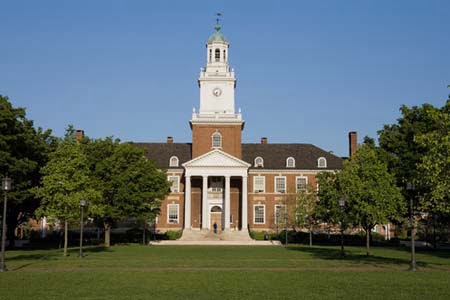
Johns Hopkins University


Date posted: October 26, 2004

In a conference at the Central Asia-Caucasus Institute (CACI) at the Johns Hopkins University, Turkish schools in Central Asia were closely analyzed.

In a conference titled ‘Turkish way of Islam Educates Central Asians’, which Dr. Bayram Balci from the French Institute of Anatolian Studies in Istanbul attended as lecturer, the educational movement initiated by Fethullah Gulen and its activities in the region were discussed.

Speaking in the conference, which was opened by the director of the Institute, Professor Charles Fairbanks who is also recognized as one of the authorities on Central Asia, Dr. Balci expressed that he finds the schools ‘very successful’. Balci, who researched the region and Turkish schools there between 1996 and 1999 for the French Grenoble University, submitted his studies as a dissertation which has been published as a book in France. According to Balci, schools in countries like Kazakhstan, Uzbekistan, Kyrgyzstan, Tajikistan, Turkmenistan, Azerbaijan, and Georgia are magnets for people as well as the elites of the region due to their high rates of success in student matriculation in the university entrance exams, as well as the prizes they win in the Science Olympics. The underlying factors for this achievement are listed as: modern education and equipment; highly motivated teachers; a dormitory system; weakness of local education; the absence of corruption.

Indicating that the schools were admired by both Turkish diplomatic representatives in the related countries and the local administrations, Balci announced that in these schools education in positive sciences is in English, Turkish, Russian, and local languages and the curriculum is secular. Which prompts the question of where Islam stands in these schools. Balci said: “The first principle of the schools is not to convert people to Islam, but to turn them into qualified people.” He went on to say that students are educated as decent and patriotic individuals and added that the religious activities should be evaluated within the framework of the moderate ‘Turkish way of Islam’.

Source: Today’s Zaman, 25 October, 2004

Tags: USA, Turkish schools


Related News

Kazakhstan presents medals to Turks for contributing to bilateral relations

Kazakh Ambassador Canseyit Tüymebayev thanked the businessmen who invested in his country and the educators who opened schools in Kazakhstan despite the risks right after the nation declared its independence 20 years ago. Tüymebayev presented medals to Harun Tokak and Ali Tokul among others. AHMET TEMİR , İSTANBUL Turks who have contributed to Turkish-Kazakh relations […]

Erdogan – Turkey’s desperate president

There is a curious reluctance on the part of the Turkish government to carry out an in-depth investigation of the coup, but the blame has been put unequivocally on an erstwhile ally, Fethullah Gülen, a reclusive Turkish imam resident in Pennsylvania, and the cadres of his movement, which enabled Erdogan and the AKP to come to and hold power.

Bringing Peace While Breaking Fasts

During the month of Ramadan iftars, or fast-breaking meals, are an important way to strengthen relations in the community.

Only educational efforts of groups such as Hizmet can eradicate extremism

In sharp contrast to Boko Haram, there is a faith-inspired group, a civil society movement that engages in education, dialogue and charitable activities and has grown out of Muslim grass roots. Check out how disturbed Boko Haram is about Hizmet’s education campaign, which offers opportunities for both boys and girls. Check out how ISIL publications outline exactly how they hate the Hizmet movement’s efforts and why they see Hizmet as their “enemies.”

Turkish schools

About 15 years ago, I attended an international academic conference in a state located within the former Soviet geography. These conferences give us the chance to make on-the-spot observations about changes around the world. There were two Turkish high schools in the city: a state school, run by the Turkish Republic under bilateral agreements, and a private school run by Turkish entrepreneurs inspired by the ideas of well-respected Turkish-Islamic scholar Fethullah Gülen. I visited both and talked to students and teachers.

‘Hizmet is really something that demonstrates what’s universal about Islam.’

People who identify with the Hizmet Movement really have influenced the way I view it, in that I can see that it’s gonna have a lasting impact, because Hizmet is really something that demonstrates what’s universal about Islam, for the members of the Hizmet Movement, that there are universal values that you find in other faith traditions as well.

Latest News

Turkish inmate jailed over alleged Gülen links dies of heart attack in prison

Message of Condemnation and Condolences for Mass Shooting at Bondi Beach, Sydney

Media executive Hidayet Karaca marks 11th year in prison over alleged links to Gülen movement

ECtHR faults Turkey for convictions of 2,420 applicants over Gülen links in follow-up to 2023 judgment

New Book Exposes Erdoğan’s “Civil Death Project” Targeting the Hizmet Movement

European Human Rights Treaty Faces Legal And Political Tests

ECtHR rejects Turkey’s appeal, clearing path for retrials in Gülen-linked cases

Erdoğan’s Civil Death Project’ : The ‘politicide’ spanning more than a decade

Fethullah Gülen’s Vision and the Purpose of Hizmet

In Case You Missed It

Under Erdogan oppression, autocracy rules in Turkey

Kimse Yok Mu extends help to Afghan quake victims

Vague terrorism charge used to target supporters of the Gülen movement: UN special rapporteurs

Inside the eye of Turkey’s political storm, in rural Pennsylvania

Norway reports 409 Turkish asylum seekers in past 18 months

Erdogan set up Maarif Foundation to seize Hizmet-inspired Turkish Schools

Turkish American Society Builds Bridges

Copyright 2026 Hizmet News