Turkish Schools for a Brighter Future in Somalia


Date posted: February 26, 2013

YASİN KILIÇ | MOGADISHU

Future of Somalia, striving to combat the famine that the civil war and severe drought left behind, is raised at Somali-Turkish schools in the country. A total of 390 students -30 elementary and 360 high school- are receiving education at three different schools operated by Nile Institutions.

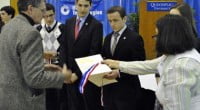
On February 21, Bedir Somali-Turkish High School students hosted a group of Turkish guests with a special ceremony held on their honor. The event kicked off with Somali and Turkish national anthems, followed by Nile Institutions Deputy General Manager Murat Kilic’s introductory speech on the schools’ background: “Nile Institutions started its activities on May 1, 2011 with the certificate granted by Somalia Ministry of Internal Affairs. We serve the needs of Somali people in the fields of education, healthcare and humanitarian aid. Bedir High School with its dormitory facilities is currently home to 240 students. Kiblenuma Primary School setting off on 2012-2013 now offers education to 30 students. Moreover, Vifak Turkish-Somali School in northern city of Herseysa is in service of 120 students, since again 2012-2013 academic year.”

Kilic also noted that the schools’ equipment and supplies including desks, computers, smart boards and laboratory materials are provided from Turkey. “By offering English-medium instruction in physics, chemistry and biology we enable our students to easily integrate into the world. Besides, through Turkish classes, our students are able to speak, sing and recite poems comfortably in Turkish” said Kilic.

According to Kilic, Bedir students achieve fluency in speaking Turkish, English, Arabic and Somali languages by the time they graduate. “Being the most modern school across the country, our students have proudly represented their nation by winning bronze medals last year in International Computer Olympiads in Tanzania, INEPO Environment Olympiads in Azerbaijan, and Turkish Language Olympiads. We, on the other hand, have the privilege of delivering the aids donated by honorable Turkish people, who are cutting down on their own children’s expenses, for their fellow Somalis.”

In the last part of the ceremony, the Somali students sang well-known Turkish songs “Gesi baglari” and “Adini kalbime yazdim, by Tarkan” concluding the event.

Source: Cihan News Agency, 22 February 2013. English translation is retrieved from Hizmetmovement.Com


Related News

Former AK Party minister praises Turkish Olympiads

Former interior minister and Justice and Development Party (AK Party) İstanbul deputy Abdulkadir Aksu said on Thursday that Turkish schools abroad serve as islands of peace, adding that he is looking forward to this year’s Turkish Language Olympiads.

66,000 students relocated after Turkish government shut down 15 universities over coup charges

Turkish government has closed down 15 universities across the country over their alleged links to the Gulen movement since last summer, leading 66,000 students to look for somewhere else to continue their education.

Georgian NGOs Stage Protest in Support of Arrested Turkish College Manager

Non-Governmental Organizations (NGOs) have gathered at the government administration in support of Mustafa Emre Cabuk, one of the managers of the Turkish Demirel College, who was sentenced to three-month pre-extradition detention.

Symposium concludes: Hizmet movement contributes to world peace

Professors said that Hizmet is an anti-violence group that uses education and dialogue to achieve its goals. Dr. Amidu Olalekan Sanni, Lagos State University, Nigeria: “I think the Hizmet group has been very influential in terms of human development, basically in the area of education and health. The first Hizmet university is actually based in the Nigerian capital of Abuja.”

Why is Erdoğan hostile to Turkish schools?

The Hizmet movement has had considerable successes in the field of education. While its share in the Turkish education sector is not colossal, the quality of its services stands out.

Fighting poverty, ignorance and disunity in Ghana; the TUDEC experience

The fight against poverty, ignorance and disunity is a shared responsibility among the government, the private sector, civil society and non-governmental organizations. The reason is that the government alone does not have the requisite human and capital resources to sustain this struggle.

Latest News

Sacramento leaders gather for Iftar dinner in celebration of Ramadan

SEO Skill Suite: Tools for Keyword Research, Technical & Backlink Analysis

Turkish inmate jailed over alleged Gülen links dies of heart attack in prison

Message of Condemnation and Condolences for Mass Shooting at Bondi Beach, Sydney

Media executive Hidayet Karaca marks 11th year in prison over alleged links to Gülen movement

ECtHR faults Turkey for convictions of 2,420 applicants over Gülen links in follow-up to 2023 judgment

New Book Exposes Erdoğan’s “Civil Death Project” Targeting the Hizmet Movement

European Human Rights Treaty Faces Legal And Political Tests

ECtHR rejects Turkey’s appeal, clearing path for retrials in Gülen-linked cases

In Case You Missed It

Turkey: Babies behind bars

Welcome to the Republic of Paranoia

Gülen: Society not divided into Kemalists, Muslims in Turkey

Turkish gov’t planning slaughter of jailed Gülen followers in staged riot, lawyer claims

Turkey’s tryst with democracy (2)

Russian analyst: Turkey’s claim Gülen was behind envoy’s killing insult to ‘our intelligence’

34 housewives arrested over Gülen links in İstanbul

Copyright 2026 Hizmet News