
Final declaration of the 33rd Abant Platform: “Turkey direction”
Date posted: June 24, 2014
ABANT
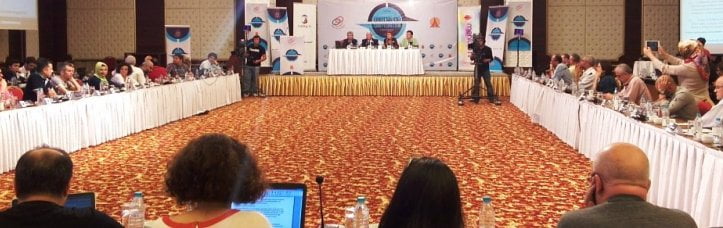
Participants in the 33rd Abant Platform, which ended on Sunday in the northwestern town of Akçakoca, agreed that Turkey has lost its direction in both its domestic and foreign policy, saying the way to rectify this is to restore its commitment to the accession process into the European Union and the rule of law at home.
“While Turkey was a country that had a certain direction in foreign policy, it has recently begun to give the impression that it does not have any direction. Turkey’s current situation could be summarized as the outlook of a Western country that is not Western and an Eastern country that is not Eastern,” said a 21-article declaration released after a three-day meeting on June 20-22 that focused on “Turkey’s Direction.” Attending the sessions were around 120 distinguished participants.
According to the Abant Platform’s conclusions, Turkey’s policy of supporting the democratic aspirations of the people of the Middle East was an appropriate choice, even though Turkish policy eventually resulted in the isolation of Turkey in the region because Ankara failed to play the role of an impartial actor. The declaration emphasized that Turkish foreign policy should not be shaped according to sectarian and ideological objectives but should focus on democracy and the rule of law.
It is time, said the declaration, for Turkey to revise the parameters of its foreign policy, at a time when the Middle East is in a process of transformation, and turn towards the EU again, because it cannot achieve its aspirations of having influence in the Middle East without restoring its values of democracy and human rights at home.
On the session titled “Turkey’s Place in the Global System,” the final declaration said that up until recent years Turkey had applied a consistent foreign policy based on following the path to the EU and principles upheld by the 28-nation bloc, emphasizing fundamental freedoms and rights, but it has now lost its direction.
Turkey began its accession talks with the EU in 2005, but the accession process has virtually came to a halt, first amid the Cyprus dispute and a reluctance on the part of some EU countries to allow Turkey in and more recently due to the deteriorating human rights and freedoms in Turkey.
Electoral threshold should be brought below 10 percent
In a recommendation aimed at improving democratic standards, the declaration also emphasized that the Turkish Parliament should pass the necessary legislation to bring the current electoral threshold below 10 percent, arguing that the current 10 percent threshold is preventing proper participation from varied segments of society in the political system. The declaration stated that confining policy-making only to political parties is a huge mistake, saying that representatives of civil society, the media, professional associations and individuals should be included in the policy-making process. The current electoral threshold prevents many segments of society from participating in the policy-making process, said the declaration.
Lamenting the existence of restrictions on individual freedoms and censorship by state institutions on the channels of information, the declaration called for the removal of such restrictions so that voters are properly informed about issues that concern to them.
On the issue of political participation, the Abant Platform said that limiting citizens’ role to the simple act of going to the ballot box to vote should be considered anti-democratic, saying voters should be able to be properly informed about issues of concern before going to the ballot box.
Continuing to focus on civil society and its role in politics and the policy-making process, the declaration also stated that civil society plays a great role in blocking the state’s arbitrary political decisions in the public sphere but that it cannot grow to become an influential actor due to existing restrictions on transparency and accountability.
Rule of law and separation of powers should not be violated
Speaking on the rule of law and separation of powers, the Abant Platform claimed that Parliament has lost its efficiency as a legislative power, calling for urgent measures to ensure the principle of separation of powers is upheld.
An independent judiciary is also vital for a strong democracy, it said, calling for measures to prevent the government from interfering in the functioning of the judiciary.
In what appeared to be praise for recent rulings of the Constitutional Court that forced the government to lift bans on YouTube and Twitter, the declaration said: “At a time when fundamental principles such as the separation of powers and checks and balances, which are indispensable components of a sound democracy, are being undermined to favor the ruling party, the existence of constitutional institutions that lend support to freedoms and refrain from political contention should be appreciated.”
ABANT PLATFORM DECLARATION:
Turkey’s place in the global system
1. While Turkey used to be a country which had a certain direction in its foreign policy, it has recently begun to give the impression that it does not have any direction. Turkey’s current situation could be summarized as the outlook of a Western country which is not Western and an Eastern country which is not Eastern.
2. While Turkey’s support for the demand for democracy in the Arab world was a correct choice in principle, the fact that the country failed to keep its impartiality in the realization of its choice has led to its isolation in the region. There is a need for a sound foreign policy which is not focused on religion, sect, ideology or identity but based on universal values such as human rights, pluralistic democracy and the supremacy of law.
3. While the Middle East is undergoing a transformation process, it is time to revisit the parameters of Turkish foreign policy. There is a need for a foreign policy understanding based on new and sound analyses. Turkey’s not having ambassadors in three Middle Eastern capitals — Cairo, Damascus and Tel Aviv — is one of the obstacles preventing effective foreign policy management.
4. Turkey’s giving meaningful messages to the Middle East and its claim to have a say in the future of the region remains groundless, considering the country’s failure to address its domestic matters concerning democratization, human rights and equal citizenship.
5. Turkey should turn its direction to the EU again and it should make use of new opportunities while the EU is revisiting its institutions.
Civil society and political participation
6. In democracies, politics is not left only to politicians; everyone can participate in politics. The only way to participate in politics is not to establish a political party. Since politics is an activity aimed at building a common niche for the society, civil society organizations — except for political parties, media, vocational organizations and individuals — are the other fundamental actors of political sphere. In addition to this, the current 10 percent threshold narrows down the political domain, helps some parties cartelize and prevents various circles of the society as well as new political movements from being represented in Parliament, hence it hinders political participation.
7. When channels of accessing information are not available, when freedoms are limited through censorship and pressure, voters cannot have complete and accurate information. Under these conditions, elections and votes lose their links to democracy. Demoting political participation to voting alone and not allowing voters to continuously follow political developments and reacting to them by making use of the sources provided by the socio-economic and technological developments in the world — hence preventing them from ruling themselves — is anti-democratic.
8. The civil society, which is needed to protect citizens against the state’s possible arbitrary practices in the public sphere, cannot develop and has difficulty in fulfilling this fundamental mission due to the limits the state has imposed on transparency and accountability.
Democratic and sensitive-to-environment development
9. Economic growth which disregards humans and environment but is only based on getting wealthy is unacceptable. The strengthening of democracy and the maintenance of a state of law are important opportunities for the improvement of the country’s economic wealth as well. Economic welfare is not seen only as an economic growth concept in the 21st century; it is seen as a concept which has social, ecological and economic sustainability at the same time. So, it is necessary to adopt a growth model which respects fundamental human rights, human dignity and the environment during the economic development process.
10. The main determiner of public investment should be expertise, participation and transparency. The realization of public investment through objective environment impact assessments and negotiations with all relevant bodies including local administrations and universities is of crucial importance for the effective use of public sources.
11. There is a need for an overhaul of working conditions in Turkey with a human-based understanding, the signing of relevant international treaties to this effect and an implementation of world standards in work life.
12. There is a benefit concerning sustainability in revisiting Turkey’s development mentality based on added value, innovation and research and development.
System debates and separation of powers
13. One of the most important principles in a modern, democratic system is the system’s being an effective one. Legislative bodies in Turkey no longer carry the title of fundamental institutions making laws. The importance of the legislative body has increased to holding to account the executive body, to balance it and supervise it. To this effect, ongoing activities in the organs of the Turkish Parliament should be able to effectively call the executive body to account.
14. In this context, the principle of the separation of powers should be implemented as soon as possible in order to strengthen democracy, and the independence of the judiciary is of the utmost importance to achieve this. In order to maintain the independence of the judiciary, not on paper but in practice, there is a need to establish a legal guaranty for judges. This requires a prevention of the executive body’s interference with members of the judiciary. Only under such a guaranty can the judiciary perform its function in accordance with impartial principles of law alone.
15. In a similar vein, there is an obligation for laws to be implemented truthfully and independently, in addition to the protection of fundamental rights and freedoms to establish a public bureaucracy which is protected from partisanship and favoritism and based on competence.
16. As a matter of fact, amendments that will reinforce the separation of powers should be made by strengthening local administrations and integrating them into the political system in a way to support checks and balances.
Problems of democratic representation: pluralism and majoritarianism
17. It is historically known that majoritarianism has the potential to evolve into tyranny at any time. Concrete examples of majoritarianism include passing omnibus bills without allowing them be discussed at length by the public, refusing to be transparent, reducing accountability to the public to election processes, and provoking polarization.
18. The constitutional amendments of 2010 weakened the tutelary institutions, but a lack of democratic institutions that can limit political power paved the way for the emergence of majoritarian practices. What we need today is to create new legal restrictive mechanisms.
19. At a time when fundamental principles such as the separation of powers and checks and balances — which are indispensable components of a sound democracy — are being undermined in favor of the ruling party, the existence of constitutional institutions which support freedoms and abstain from political contention should be appreciated.
20. Building policies on traumas stemming from victimization, grievances and hostilities leads to new traumas or new “otherizations.” It is essential for politics to refrain from “otherization,” to instil confidence in society and to exhibit its sincerity in order to contribute to the healthy development of the society.
21. Social peace can be achieved if a pluralistic mentality is adopted instead of majoritarian discourses and practices, so that everyone can have equal access to civil rights in practice, given the fact that democracy is a system that should protect the rights of all groups.
Source: Abant Platform , June 22, 2014
Tags: Abant platform | Democracy | Hizmet (Gulen) movement | Turkey |


