A Trip to Turkey: Religious Practice and the Secular State

Date posted: September 19, 2008
Bishop Arthur J. Serratelli
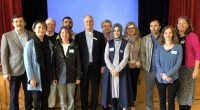
Beyond the borders of Turkey, the city of Konya is well-known. Located just south of Ankara, it is Turkey’s most religiously conservative city. On the trip I made this summer with the Interfaith Dialog Center, all of us, Catholics, Protestants and Muslims, were excited to visit this center of Sufi mysticism. Konya is the burial place of Rumi, the famous Sufi mystic. It has also been the home of the Whirling Dervishes for the last 800 years.
The Whirling Dervishes belong to the vast Sufi tradition of Islam. The dance of the dervish represents the earth revolving on its axis while orbiting the sun. The dervish whirls in a precise rhythm with both arms extended. The right palm faces up and the left palm faces down. This represents the energy from the heavens as it passes from above through the body to the earth below. The music and the dance are designed to induce a state of meditation on the love of God.
With the rise of secularism in Turkey, the Mevlevi Order of Dervishes was outlawed in 1925. The dervish lodge we visited today is a museum. However, ever since the 1950s, the Turkish government has permitted the Whirling Dervishes to perform annually in Konya on the anniversary of the death of Rumi, their spiritual father.
We also visited the tomb of Rumi. It was covered with a large velvet cloth embroidered in gold. Rumi was a 13th century poet, jurist and theologian. He advocated unlimited tolerance and charity. Today, Turkey, Iran and Afghanistan claim him as their national poet. Visiting the tomb of this younger contemporary of St. Francis of Assisi made me aware of the longing within the human heart of people of every culture to soar above the prose of everyday life and have an experience of God. Pilgrims still visit this tomb. No age outgrows its need for true teachers of authentic spirituality.
Stopping in Konya, I had to take a step back from the present day monuments to remember that Konya is Iconium of the New Testament. Here St. Paul preached during his first mission with St. Barnabas. They had some success in winning a good number of Jews and pagans to the Christian faith (Acts 14:20). Paul also made a second visit to Iconium to organize the church had founded (Acts 16:2) His stay in Iconium was not long because of the persecution he faced (2 Timothy 3:11). In Konya today, Christianity is a past memory.
We also visited Cappadocia. The place reminded us of the great price that Christians have paid to keep their faith alive. Our small group of six descended into the cool underground cities in Cappadocia. We went back in time to the days when the early Christians had to flee here to avoid persecution. Fidelity to one’s faith costs!
Leaving the dark hovels beneath the ground, we came back in the blazing sun. We climbed the steep ascents to a number of small churches carved in the mountain rocks. Their faded icons evoked the memory of the many monks that had populated Cappadocia in the fourth century. It was in this spiritual environment that the great theologians St. Basil, St. Gregory of Nyssa and St. Gregory Nazianzus opened the Church’s conversation with learned Greek-speaking intellectuals. Though the small churches of Cappadocia are empty tourist attractions, the voice of the faith that once lived there is still heard in the Nicene Creed which we recite at Mass.
For me, the highlight of the trip was Ephesus. It is the largest Roman excavation in Turkey. In the first century A.D., Ephesus was an important center for Christianity. During his third missionary journey, the Apostle Paul came to Ephesus. He worked with Priscilla and Aquila, as well as Apollos in spreading the faith. He stayed here longer than in any other place. Standing in the city’s amphitheater that sat 24,000 people, we could almost hear the chorus of angry shouts led by Demetrius, the silversmith. Paul’s preaching was destroying their business of making idols. They preferred Diana, the goddess of fertility, to Christ, the true God.
From high on a hill overlooking the plain below, we saw the place where once proudly stood the Temple of Diana. In its day, it was the largest temple in the world. It was one of the Seven Wonders of the World. Of its 127 ancient marble columns, just one stands today as a lonely witness to a dead religion. On the same hill where we stood was the great basilica that the Emperor Justinian built over the tomb of the Apostle John. This, too, was in ruins.
In a field below, we walked amidst the stones where the Council of Ephesus met in 431 A.D. Nestorius, the eloquent and popular Patriarch of Constantinople, had been teaching that in Christ, there was a divine person dwelling in a human person. The Council of Ephesus defined the true faith in Christ as one person with two natures, human and divine. Christ is the second person of the Blessed Trinity who assumed our human nature.
To defend the true divinity and complete humanity of Jesus, the Council proclaimed Mary who bore him to be truly the Mother of God, Theotokos. From the East came the true understanding of the role of Mary in the economy of salvation. To the East we owe our great love of Mary.
We concluded our visit to Ephesus by tracing the footsteps of three great Popes, Paul VI, John Paul II and Benedict XVI. Like them, we made the ascent up the side of Bulbul Mountain, just a few short miles from the ancient city of Ephesus, to the home of Virgin Mary. Here Mary and John lived together for the last years of their lives. Every year, thousands of pilgrims visit this home. Both Christian and Muslims come here to pray. In both religions, there is a special reverence for the Mother of Jesus. Christians and Muslims together: this was at the heart of our interfaith journey together.
We returned to Istanbul where we had begun our journey. We joined the bargain hunters searching the Kapali Çarsi (Grand Bazaar) for spices and jewelry and clothes. We paraded with other museum-goers through Topkapi Palace overlooking both Marmara and Bosphorus. Once the setting for affairs of state and royal entertainment, this home of the sultans for nearly four centuries is now a tourist attraction.
Istanbul is literally and culturally a city divided. As the Bosporus strait literally divides the city between two continents, so the history of Istanbul and Turkey stands divided. Istanbul boasts modern buildings, fast foods and billboards sporting the latest Western styles. Yet, its skyline is crowded with the domes and minarets of mosques that beckon the believer to prayer. Perhaps more than any other time in history, the city represents the great cultural division of East and West.
With the collapse of the Ottoman Empire, there has been a move toward a secular state. With its 1924 constitution and the Reforms of Atatürk, the Turkish government has set about establishing a modern, democratic, secular state. Ninety-nine percent of its citizens are Muslims.
Unlike the Ottoman Empire with its zeal for Islam, the present government of Turkey does not recognize any official religion. Headscarves are not permitted in state offices, schools and public universities. Yet, we saw most woman wearing headscarves identifying themselves as devout Muslims. No matter what time of day, mosques are visited by devout men, women and children who prostrate themselves facing Mecca in an act of worship of God.
Everywhere we visited, we saw the ruins of history and the revival of religious fervor, the struggle to hold on to the past and the thrust to become part of the modern world. I left Turkey with a sense of a people who live in a state that is secular, yet practice their faith openly.
I came home with a deep respect for our Muslim hosts, for their commitment to live and share their faith, and for their desire to be part of the modern world without sacrificing their religious convictions. How truly important and vital to society is the faith and the practice of religion both in East and West! How much, as Catholics, we can offer others in their search for God!
Source: The Beacon, September 18, 2008, http://www.patersondiocese.org/article.cfm?Web_ID=2726
Tags: Dialogue | Turkey trips |