Academics, civil society call for freer, more diverse universities in new law

Date posted: December 10, 2012

BURAK KILIÇ / HASAN KARALI, İSTANBUL

Participants of a meeting hosted by the Zaman daily have called on the Higher Education Board (YÖK) to grant universities broader freedoms instead of the existing centralized structure under a new YÖK Law.

The current YÖK Law is considered outdated and carries traces of former coups as it was launched right after a military takeover in 1980. Turkey had 27 universities in 1980 when the law was enacted, compared to the more than 160 universities currently established. YÖK plans to replace the law with a newer, more liberal one.

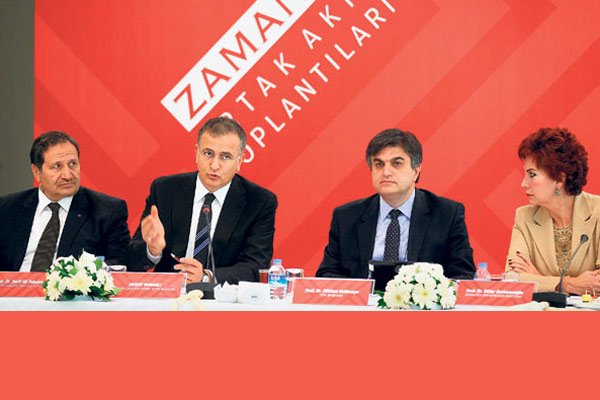
The Zaman daily hosted an event, “Ortak Akıl Toplantısı” (Common Wisdom Meeting) on Saturday to discuss the new law with experts from various circles, including rectors, academics, civil society representatives, businessmen and YÖK members. Participants mainly complained that the country’s universities have a centralized structure under the existing YÖK law, and the structure should be replaced with a more liberal one under the new law.

In early November, YÖK opened a draft bill for public discussion. With the new law, YÖK plans to diversify universities and transform them from monotype to diversity. According to the draft bill, rectors of universities will be elected by members of the board. Currently rectors are appointed by the Turkish president from a pool of candidates selected by members of each university. The draft bill also suggests that students and civil society organizations will be represented in the board.

The Zaman daily’s Editor-in-Chief Ekrem Dumanlı expressed his opinion that the meeting would contribute to the drafting of a better law by YÖK. “We hope that Turkey will have freer universities. We want universities to be more open to sciences, arts, literature and thought,” Dumanlı noted.

YÖK President Gökhan Çetinsaya, in response, said the intention of the board is not solely to replace its law. “YÖK also wants to transform universities into places that meet the needs of Turkey and the world in the 21st century. We are mainly focusing on diversity. This is a response to the [current] monotype,” he stated.

Professor Durmuş Boztuğ, the rector of Tunceli University, said the new law would allow national will to be represented and reflected in universities as some YÖK members would be appointed by the president, who is elected by the people. “I think the new law will contribute to the autonomy of universities,” he added.

Under the new law, the name of the board will also change. The bill proposes to change the name of the institution to the Turkish Higher Education Board (TYÖK). This is also open for discussion.

University Instructors’ Association head Tahsin Yeşildere said the autonomy of universities should be clearly defined under the new law and universities should be free from all forms of tutelage. “Looking back in history, we see that universities were born as institutions to fight churches. In our day, universities should be independent of religious tutelage and institutions. They should also be independent from organizations that provide financial sources to companies. We can only talk about freedom of universities under these conditions,” he noted, adding that the new YÖK law should challenge the existing centralized system in the Turkish education system.

Yeşildere also said the new law should provide broader freedoms to academics. “Freedom of academics is a must for universities to function properly,” he added.

Source: Today’s Zaman December 9, 2012


Related News

Yamanlar College student becomes world math champion

ISTANBUL Osman Akar, a student from the private Yamanlar College in İzmir, has won a gold medal at the 55th International Mathematical Olympiad (IMO), which was held in Cape Town. Students from 106 countries around the world participated in the event from July 3-13. Akar was among students on a math team chosen by the […]

Arınç calls Gülen’s extradition request a ‘political move’

Speaking to journalists following the Cabinet meeting on Monday, Arınç added that he does not know how US would react to this political request. Admitting that there is no legal base for Gülen’s extradition, the deputy prime minister said that without the necessary documents, evidence and a court order, it is not possible to get someone extradited from a country.

Turkey’s Corruption Probe, And One Question For Erdogan

Figures close to the leading Justice and Development Party (AKP), including sons of cabinet members, are facing serious allegations of bribery and money laundering. The government is denying all accusations and claims the charges are part of a conspiracy with roots both foreign and domestic.

Michael Flynn, President Trump’s first national security adviser, was paid to investigate Fethullah Gulen during election campaign

Michael T. Flynn, President Trump’s first national security adviser, acted as a foreign agent representing the interests of Turkey’s government in exchange for more than $500,000 during last year’s campaign even as he was advising Mr. Trump. Mr. Flynn was assigned to investigate Fethullah Gulen, a Turkish cleric who lives in Pennsylvania.

Erdogan’s Journey – Conservatism and Authoritarianism in Turkey

What happened to Recep Tayyip Erdogan? The Turkish president came to power in 2003 promising economic and political liberalization. But under his rule, Turkey has instead moved in a profoundly illiberal, authoritarian direction, which some feared was Erdogan’s true agenda, given his background in Islamist politics. Rather, Erdogan has become something more akin to a traditional Middle Eastern strongman: consolidating personal power, purging rivals, and suppressing dissent.

Turkey’s once-worldly aims falter, even close allies concerned

Power appears to have gone to the prime minister’s head. Angling to become president in order to extend his rule, Erdogan is foolishly profiling and purging former friends in the Hizmet movement, recently firing hundreds of government employees who are allegedly (no one knows for sure as there’s no evidence) sympathetic to the movement’s founder, Fethullah Gulen

Latest News

Turkish inmate jailed over alleged Gülen links dies of heart attack in prison

Message of Condemnation and Condolences for Mass Shooting at Bondi Beach, Sydney

Media executive Hidayet Karaca marks 11th year in prison over alleged links to Gülen movement

ECtHR faults Turkey for convictions of 2,420 applicants over Gülen links in follow-up to 2023 judgment

New Book Exposes Erdoğan’s “Civil Death Project” Targeting the Hizmet Movement

European Human Rights Treaty Faces Legal And Political Tests

ECtHR rejects Turkey’s appeal, clearing path for retrials in Gülen-linked cases

Erdoğan’s Civil Death Project’ : The ‘politicide’ spanning more than a decade

Fethullah Gülen’s Vision and the Purpose of Hizmet

In Case You Missed It

The [Gulen] movement was a shade

Turkey’s AKP planning to blame Hizmet movement for Deep State’s crimes

Victims of forced disappearance in Turkey

Kimse Yok Mu reaches out to orphans in Mongolia

Al-Azhar professor: Gülen courageously resists radicalism

Report: Police chief sets up teams to torture post-coup detainees

Turks seek asylum in South Africa

Copyright 2026 Hizmet News