Turkey’s Crackdown on Businesses Sparks Concern

FILE - The business and financial district of Levent, which comprises leading Turkish companies' headquarters and popular shopping malls, is seen from the Sapphire Tower in Istanbul, Turkey, May 3, 2016.


Date posted: October 24, 2016

DORIAN JONES

The Turkish government crackdown that followed the failed July coup is expanding to businesses, with the assets of major multibillion-dollar conglomerates seized, along with hundreds of smaller companies.

Earlier this month, three of Turkey’s most prominent businessmen, the Boydak brothers, appeared in handcuffs at their mother’s funeral.

Their multibillion-dollar Boydak Holdings was seized and they were jailed, accused of being linked to U.S.-based cleric Fethullah Gulen, whom the government blames for the coup attempt.

Istanbul-based political consultant Atilla Yesilada of Global Source Partners said Boydak’s seizure was part of a much wider crackdown on business.

Hundreds of companies

“So far, unofficial data [show] over 300 companies have been taken into receivership or administership, total assets roughly $15 billion. These are substantial numbers,” Yesilada said. “But once the prosecutors get their hands on one company and look through the accounts, they discover interlocking shareholder relationships that lead to other companies. My personal contacts in the banking industry tell me they have received orders to freeze all accounts of a substantial number of companies. So they have not really reached the bottom of barrel.”

Yesilada said the crackdown has not posed a systematic threat to the Turkish economy, with the country’s key businesses escaping investigation. Most of the companies seized have been taken by government decree under emergency powers.

Selin Sayek Boke, a former World Bank adviser who is now spokeswoman and deputy head of the main opposition Republican People’s Party, warned that the arbitrary seizures called into question the prospect of doing business in Turkey.
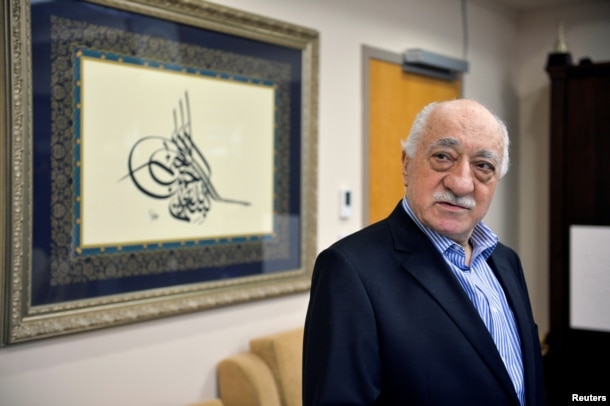
FILE - U.S.-based cleric Fethullah Gulen at his home in Saylorsburg, Pa., July 29, 2016.

FILE – U.S.-based cleric Fethullah Gulen at his home in Saylorsburg, Pa., July 29, 2016.

“If the rules of the market are rewritten by the day, then it creates a huge uncertainty. … We all know that private investment, domestic or foreign, only happens if it knows the rules of the game, if there is rule of law,” she said. “It is very difficult to speak of such an environment. Under such conditions, would you have investment in the country? You would not.”

Analysts said international long term investment in Turkey was in decline before July.

Disposal of assets

There are growing questions about how the seized companies will be disposed of, with allegations that many will be sold off to people with close links to the government and president — a charge the government strongly denies. Criticism is also growing over the lack of clarity on the rights of those owed money, or “payables,” by seized companies.

Yesilada said such ambiguity is leading to growing fear and suspicion in the business community.

“There is an intimidation factor. … The payables of a company would be delayed for a very long time, once it’s taken under receivership,” he said. “Any company suspected by rumors of being affiliated with Gulen immediately loses all supply credit and bank loans. So the impact is clearly substantial.”

It remains unclear how much Turkish banks are owed by the seized companies, but those liabilities are set to grow, with the government promising no end to the crackdown. Analysts warn that means more unemployment. An estimated 200,000 people already have lost jobs, about 1 percent of Turkey’s workforce.

Source: VOA , October 19, 2016


Related News

Fethullah Gulen Denies Coup Involvement

Fethullah Gulen, a Muslim cleric living in self-exile in the U.S. and a political rival of President Recep Tayyip Erdogan of Turkey, insisted Saturday that he had no involvement in Friday’s attempted coup.

Erdogan’s Journey – Conservatism and Authoritarianism in Turkey

What happened to Recep Tayyip Erdogan? The Turkish president came to power in 2003 promising economic and political liberalization. But under his rule, Turkey has instead moved in a profoundly illiberal, authoritarian direction, which some feared was Erdogan’s true agenda, given his background in Islamist politics. Rather, Erdogan has become something more akin to a traditional Middle Eastern strongman: consolidating personal power, purging rivals, and suppressing dissent.

Can a Post-Coup Turkey Get Along with Europe?

None of this has stopped the government from undertaking a huge, self-destructive purge, with around 10,000 people arrested, 100,000 people dismissed, and the seizure of assets of more than $4 billion, numbers that worry not just human rights activists but foreign investors as well. The government’s fury is understandable but it should distinguish between those who took part in the coup and those who simply belonged to the Gulen movement.

To escape from Turkey, they told their children it was a game

A Turkish family that was victimized by a government purge of the Gülen movement following a failed coup in July 2016 has fled to Greece in an inflatable boat, telling their children it was a “game,” Euronews reported on Tuesday.

‘If you are against us, you are the other’

Turkey has been witnessing a rigorous debate for the last couple of weeks over the ruling Justice and Development Party’s (AKP) vow to finish off the test prep schools, which are a source of both money and influence for its old ally, the Hizmet Movement led by the self-exiled leader, Fethullah Gülen. Like many controversies in Turkey, the issue of closing the courses and integrating them into Turkey’s poorly-established and -organized education system was not only about the prep schools, which was only the tip of the iceberg.

‘A movement like the Hizmet Movement is very important for correcting misconceptions of Islam’

Dr. Lawrence Geraty is a Professor of Archaeology and Old Testament Studies at La Sierra University in Riverside, California. He served as the second President of La Sierra University. He completed his PhD in Syro-Palestinian Archaeology at Harvard University.

Latest News

Sacramento leaders gather for Iftar dinner in celebration of Ramadan

SEO Skill Suite: Tools for Keyword Research, Technical & Backlink Analysis

Turkish inmate jailed over alleged Gülen links dies of heart attack in prison

Message of Condemnation and Condolences for Mass Shooting at Bondi Beach, Sydney

Media executive Hidayet Karaca marks 11th year in prison over alleged links to Gülen movement

ECtHR faults Turkey for convictions of 2,420 applicants over Gülen links in follow-up to 2023 judgment

New Book Exposes Erdoğan’s “Civil Death Project” Targeting the Hizmet Movement

European Human Rights Treaty Faces Legal And Political Tests

ECtHR rejects Turkey’s appeal, clearing path for retrials in Gülen-linked cases

In Case You Missed It

Mosaic Foundation brings together Denver’s prominent people over a friendship dinner

A Case for Why Gulen Would Never Support a Coup

Questions over corruption and paralysis of politics [in Turkey]

Turkey’s Changing Freedom Deficit

Filipino military awards Turkish high school for peace initiatives

A rising profile for Turkish Cultural Center Vermont

PM’s order echoes 2004 MGK decision [to undermine the Gulen Movement]

Copyright 2026 Hizmet News