
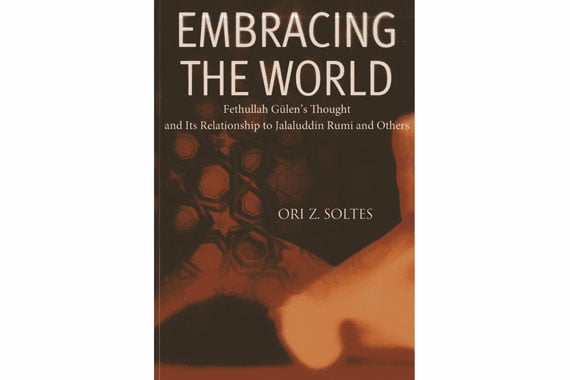
Embracing the World: Fethullah Gülen’s Thought and Its Relationship to Jalaluddin Rumi and Others
Date posted: October 28, 2013
Ori Z. Soltes
This is neither a comprehensive study of Fethullah Gülen nor is it a comprehensive study of Jalaluddin Rumi. What I am seeking to do is to explore the places where the thought of the one is echoed in the thinking of the other, either overtly or indirectly—and to note ways in which the opposite is true: that Gülen diverges from Rumi.
There is a range of distinct connections that may be found between Rumi in his time and Gülen in his time—our time. Fundamentally, the former one spoke and taught and wrote and while the latter speaks and teaches and writes of issues that reach beyond themselves, because they are not time-bound.
Ultimately a central point of discussion is to demonstrate how (without presuming to state definitively as to why), within broad intellectual, cultural and spiritual frameworks, two individuals so far apart in time can be and have been within their respective times of thinking, feeling and writing, ahead of their time—and ultimately timeless, at least to those willing to listen carefully to their respective words. Rumi’s words, as Gülen recognizes, are really directed to all humans who share the potential to hear and see and who value and seek to hear and see inwardly as much as and sometimes more than outwardly. This is a sentiment shared, in fact, by Rumi and Gülen, each of whom in his own way is an important part of exploring and explaining how to carry “this great love … inside me” out to the world.
I am also seeking to suggest some of the larger contexts in which the thinking of both resides. Given the wide-ranging aspects of their respective writings, it should not be surprising if, minimally, we can find important foundation stones in both philosophy and theology in the edifices that they each construct. Given the important role of Muslim thinkers in the era leading to and beyond the time of Rumi in preserving and transmitting the thought of the ancient Greeks, it should not be surprising to find traces of Plato in Rumi, together with important influences from prior Muslim and in particular prior Sufi thinkers. Given Gülen’s wide interests it should not be surprising to find echoes from the same array of thinkers that have come both through his own study of them and through his engagement of Rumi.
Moreover, Gülen’s intellectual interests extend beyond the era of Rumi, and thus others—notably Bediüzzaman Said Nursi—have added to the foundations of his edifice of thought. And in the long run, this narrative evolves primarily as a focus on Fethullah Gülen as one, inspired by Rumi and others, who has been a scholar of Islam who has transformed the theory of universalism into a concerted and successful plan of action on various levels.
Gülen has spent most of his life as a student of the Qur’an and of Islamic literature and lore and a good part of that time as an avid learner—like the Prophet Muhammad himself seems, by every account, to have been—of a wide range of subjects, spiritual and otherwise. He has evolved the sort of philosophy that offers a unique form of hope and potential help for a world fraught with fractiousness and contention, where greed seems to be a defining attribute of those in power and desperation of those without power.
Gülen’s vision is Islamist—in two ways: he speaks from within the deepest reaches of his own Muslim traditions, and his vision for his own country, Turkey, is that it reclaim the Muslim identity that is endemic to the last nearly thousand years of its history and to its national soul. At the same time, he is emphatically universalist: his vision is one in which each country addresses the world from within the traditions that have shaped its national soul, but all countries ultimately share a common goal: to improve the world for all humans and also for the non-human elements that make up the world. He has articulated his vision in terms of an altruistic sensibility. This is the opposite of the “me” emphasis that has been expressed by various writers and pundits in the course of history and in particular the twentieth and early twenty-first centuries. And he has pushed the growing cadre of adherents to his banner to translate the theory that he espouses into action: service to the community and ultimately the world around them. He has taught and preached and written about universal love and compassion, not only for fellow humans, but for the natural world around us.
As a practicing Sufi—an adherent of Muslim mysticism—Gülen is comfortable with paradox and has shaped his thinking in accordance with the paradoxes that are inherent in mysticism. God is within us and God is unimaginably beyond us. God is inaccessible, yet the hiddenmost recesses of God are accessible. As the mystic seeks God, God seeks the mystic. We must seek God from deep within our own tradition; there are myriad traditions from which paths lead to the same inner recess of God: the mysterion.
This is a perspective to which many mystics have arrived—and I spend a considerable amount of time in the introductory and first chapters exploring this in order to provide a solid foundation upon which readers, particularly those new to this area of spirituality, may build the edifice of their understanding. But none has articulated the idea as frequently or as lyrically as did the thirteenth-century Sufi, Jalaluddin Rumi. Thus there is a range of distinct connections that may be found between Rumi in his time and Gülen in his time—our time. Fundamentally, the one spoke and taught and wrote and the other speaks and teaches and writes of issues that reach beyond themselves because they are not time-bound.
Ultimately a central point of this discussion is to demonstrate how (without presuming to state definitively as to why), within broad intellectual, cultural and spiritual frameworks, two individuals so far apart in time can be and have been within their respective times of thinking, feeling and writing, ahead of their time—and ultimately timeless, at least to those willing to listen carefully to their respective words.
Or as Rumi put it:
I am so small I can barely be seen. How can this great love be inside me?
Look at your eyes. They are small, but they see enormous things.
(Divani Shamsi Tabriz #798)
The great love is the love of God and the love of all of God’s creation. The eyes with which he sees so much are not merely those with which we see the outside world and the outer shapes of things, but those with which we see both within and beyond. Rumi was talking to himself, but also, one might say, to Fethullah Gülen—as Gülen himself may be seen to recognize, when he writes (in the foreword to Shefik Can’s book on Rumi), that the thirteenth-century Sufi master “hastened toward God on his own spiritual journey, but in addition to this he evoked similar journeys in countless others—journeys marked by an eager striving toward God.”[1]
Gülen clearly includes himself among those countless others—which is why he wrote the foreword to Can’s book, with such obvious love and eagerness, in the first place. But Rumi’s words, as Gülen recognizes, are really directed to all humans who share the potential to hear and see and who value and seek to hear and see inwardly as much as and sometimes more than outwardly. This is a sentiment shared, in fact, by Rumi and Gülen, each of whom in his own way is an important part of exploring and explaining how to carry “this great love … inside me” out to the world.
With this last comment in mind I wish to offer my gratitude to two individuals in particular whose interest led to the bringing of this book to fruition: Ali Yurtsever, former Director of the Rumi Forum in Washington, DC who suggested it; and Emre Celik, current Director, whose constant attention led to its completion and arrival at the publishing house. I would also like to thank the editors at Tughra Press for their careful attention to every detail within my text, and for their patience and generosity of spirit.
About the Author: Ori Z. Soltes is Goldman Professorial Lecturer at Georgetown Univeristy where he teaches theology, philosophy and art history at the department of theology and he is former Director and Curator of the B’nai B’rith Klutznick National Jewish Museum in Washington, D.C., where he curated over 80 exhibitions.
Source: HizmetMovement.Com , August 30, 2013
Tags: Book reviews | Fethullah Gulen | North America | USA |


