Turkey Faces Its Iran 1979 Moment
Date posted: July 18, 2016
Soner Cagaptay
Empowered by surviving a coup, Erdogan may be tempted to encourage an Islamist counterrevolution.
Turkey is at a pivotal point in its history following the failed coup attempt of July 15. President Recep Tayyip Erdogan, having survived the coup plot, won fresh legitimacy and gained a new ally: religious fervor in the streets. Mr. Erdogan can use this impetus either to become an executive-style president, or he can encourage the forces of religion to take over the country, crowning himself as an Islamic leader.
Though the incremental acquisition of power has been more his style in the past, the powerful eruption of Islamic support for him over the weekend may prove too tempting. This is Turkey’s Iran 1979 moment—will a brewing Islamic revolution overwhelm the forces of secularism?
As the coup plot was unfolding on Friday night, Mr. Erdogan appealed to religious sentiments in the country, rallying his supporters to launch a counter-coup. On his orders, calls for prayer were issued from Turkey’s over 80,000 mosques at 1:15 a.m.—not a time when people are supposed to be praying. The strategy worked, the call to prayer acted as a call to political action, and religious Turks took to the streets in defiance of the secularist military. Together with pro-government police forces, they overpowered the military’s botched effort.
Since July 15, pro-Erdogan sentiments in Turkey have been running high. Calls to prayer continue throughout the day (Islam requires only five calls to prayer at set times daily), reminding religious Turks of their political duty to stand with the president.
Mr. Erdogan, a politician with an Islamist pedigree, came to power in 2003 as prime minister and head of the ruling Justice and Development Party (AKP). At that time, he followed a policy of economic growth to build a support base. He also moved away from Islamist politics, instead embracing reform and seeking European Union membership.
After winning electoral victories in 2007 and 2011 on a platform of economic good governance, however, Mr. Erdogan turned staunchly conservative and authoritarian.
He now regularly cracks down on freedoms of expression, assembly and association. He has shut down or taken over media outlets. He bans access to social media, locks up journalists and sends the police to harass opposition rallies.
Mr. Erdogan also promotes efforts to impose religion: In December 2014, Turkey’s Higher Education Council, a government-regulated body, issued a policy recommendation that mandatory courses on Sunni Islam be taught in publicly funded schools to all students, even ones as young as age 6.
In 2014, Mr. Erdogan, acceding to term limits, stepped down as prime minister and as the head of the AKP. He instead assumed the presidency—a formerly weak office that he has been steadily transforming. The coup gives Mr. Erdogan an excuse to press ahead with his plans to cobble together a parliamentary majority; he intends to amend Turkey’s Constitution and take over the posts of prime minister and AKP chairman in addition to being president.
This process, which would make Mr. Erdogan the most powerful person in Turkey since the country became a multiparty democracy 1950, fits into his gradualist approach to consolidating power. At the same time, it presents a risk: In the two most recent elections, Mr. Erdogan’s AKP has maxed out at 49.5% support, and although the president’s popularity has risen since the coup, there is no guarantee that this bump will last until the next elections, which, depending on when Mr. Erdogan calls them, could be as late as next year.
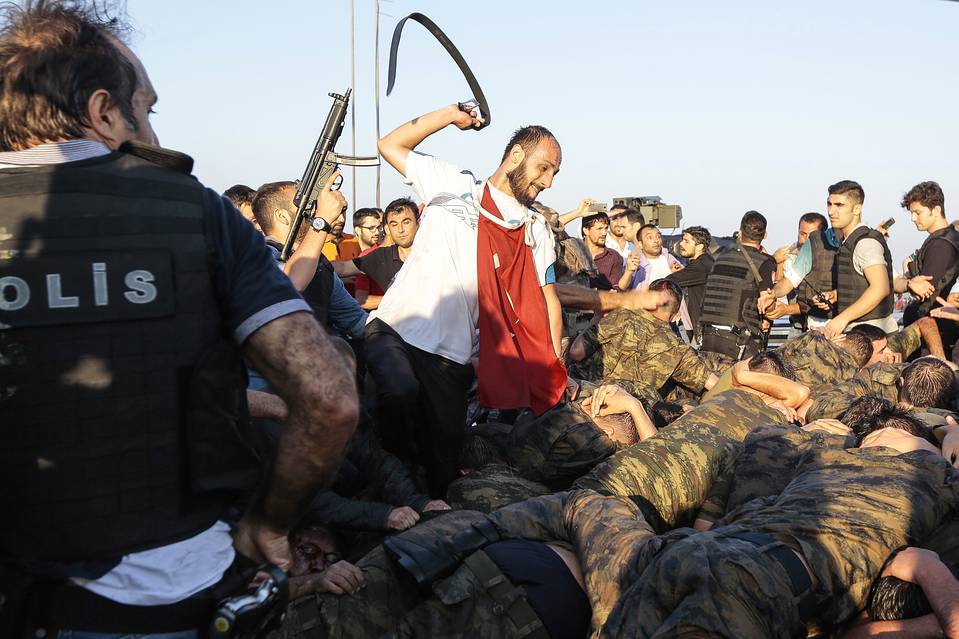
Enter a second, quicker path to power: Islamist revolution. Erdogan supporters—who took to the streets to defy the coup, and who have continued to rally throughout the country since then—are not the garden-variety conservative AKP supporters, but rather Islamists, and even jihadists. Over the weekend, pro-Erdogan mobs captured and beat soldiers who had supported the coup. Images were reportedly posted online, in the Islamic State style, of a soldier who had been beheaded.
Unfortunately, jihadist sentiments in Turkey have become increasingly noticeable lately, in no small part due to Mr. Erdogan’s education policy, as well as his Syria policy, which has allowed Islamist radicals to use Turkey as a staging ground. According to a recent poll by the Pew Research Center, 27% of Turks don’t view Islamic State unfavorably. Mr. Erdogan can now harness these forces to usher in an Islamist revolution.
Revolutions don’t require majorities, but rather angry and excited minorities that are willing to act violently to take power. Following the failed coup plot, Turkish politics has not settled down. Mr. Erdogan is still not in charge of the whole country, which is why as of Sunday afternoon he hadn’t returned to the Turkish capital. It is not yet safe for him. Religious fervor is running high; mosques continue to call for prayers throughout the day. Islamists and jihadists who are angry at the military roam the streets, while most Turks of other political outlooks are scared to leave their homes.
If Mr. Erdogan were to pump up religious fervor further, he could convert the religious counter-coup d’état into an Islamist counter-revolution, ending Turkey’s status as a secular democracy. Adding to the temptation is the fact that the military, divided and discredited in the public eye following the failed coup, is in no position to prevent a counterrevolution.
But an Islamist revolution would carry risks. Turkey would be stripped of its NATO membership, exposing the country to nearby enemies, including Russia. It would also almost certainly lead to an economic meltdown, hurting Mr. Erdogan’s power base.
The first scenario, in which Mr. Erdogan uses the coup to consolidate power, is more likely than the second, but the chances of an Islamist revolution have never been higher in Turkey.
Mr. Cagaptay is a senior fellow at the Washington Institute for Near East Policy.
Source: Washington Post , July 17, 2016
Tags: Democracy | Freedoms | Military coups in Turkey | Turkey |