
Detainees ‘beaten, sexually abused and threatened with rape’ after Turkey coup, Human Rights Watch claims

Date posted: October 28, 2016
Group claims Turkey’s state of emergency has ensured a ‘blank cheque’ for torture
SAMUEL OSBORNE
Detainees have been beaten, sexually abused and threatened with rape by Turkish police, Human Rights Watch has claimed.
In a 43-page report published on Tuesday, the human rights group said a “climate of fear” had prevailed since July’s failed coup against President Tayyip Recep Erdogan and the arrest of thousands under a state of emergency.
It said Turkey had effectively written a “blank cheque” to security services to torture people.
Turkey’s Justice Ministry has repeatedly denied prisoners are ill-treated and said a unit had been established to investigate all claims. Ankara said the post-coup crackdown was necessary to stabilise a Nato state facing threats from Kurdish militants as well as wars in neighbouring Iraq and Syria.
HRW said it had uncovered 13 alleged abuse cases, ranging from the use of stress positions and sleep deprivation to severe beatings, sexual abuse and the threat of rape. The cases were not limited to possible supporters of the coup but also included detainees suspected of links to Kurdish militant and leftist groups.
Hugh Williamson, Europe and Central Asia director at HRW, said in a statement it “would be tragic if two hastily passed emergency decrees end up undermining the progress Turkey made to combat torture.”
“By removing safeguards against torture, the Turkish government effectively wrote a blank cheque to law enforcement agencies to torture and mistreat detainees as they like,” he said.
Turkey has arrested more than 35,000 people following the coup, detained thousands more and sacked over 100,000 over their suspected links to Fethullah Gulen, a US-based cleric Mr Erdogan blames for orchestrating the coup. Mr Gulen denies the charge.
The government has said the widescale crackdown is justified by the gravity of the threat to the state on 15 July, when rogue soldiers commandeered tanks and fighter jets, bombed the country’s parliament and killed more than 240 people.
Mr Erdogan declared a state of emergency days after the failed putch, allowing him and the cabinet to bypass parliament in enacting new laws and to limit or suspend rights and freedoms as deemed necessary.
Emergency decrees have since extended the period of police detention without judicial review from four days to 30, and have allowed the authorities to deny detainees access to lawyers for up to five days, and restrict their choice of lawyer.
Eight of the cases reported to HRW took place in the immediate aftermath of the coup, before the emergency decrees were published, while five took place after they were adopted.
In one, a lawyer told HRW several detainees had been forced to undress and left out in the baking sun for hours. She said the police then severely beat them and threatened to rape them with a baton.
In a statement to the prosecutor seen by HRW, one detainee described how he was blindfolded and then beaten by police. “The police chief who detained me… began to slap me in the face and eyes,” he said. “They beat me on the soles of my feet, on my stomach, then squeezed my testicles, saying things like they’d castrate me.” He went on to describe a series of beatings on other parts of his body.
It also quoted one police officer telling a detainee: “Because of the state of emergency, nobody will care if I kill you. I will just say I shot you while you tried to run away.” It said those words were overheard by the relative of another person in detention.
HRW called on the authorities to “immediately rescind those provisions of the emergency decrees that enable abuse”.
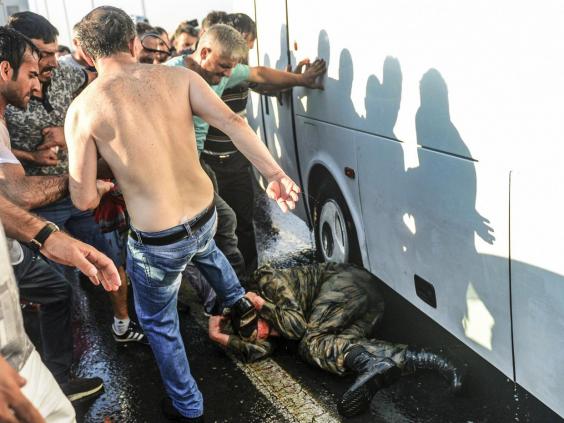
People kick and beat a Turkish soldier, who participated in the attempted coup, on Istanbul’s Bosphorus Bridge (AP)
It said the government has “the right – and even the obligation – to protect the public, investigate crimes committed during the attempted coup, including murder and causing bodily harm, and to hold those responsible to account.
“However, declaring a state of emergency does not give the government a carte blanche to suspend rights.”
Amnesty International previously said it had received credible evidence of detainees being subjected to beatings, torture and rape in the immediate aftermath of the failed coup.
Justice Minister Bekir Bozdag tweeted on Sunday to say there is no ill-treatment or torture in Turkey’s prisons, and argued Turkey was being unfairly accused. he said a special unit was established to investigate all claims.
Source: Independent , October 25, 2016
Tags: Fethullah Gulen | Freedoms | Hizmet and politics | Military coups in Turkey | Persecution of Hizmet by Erdogan | Torture | Turkey |


